
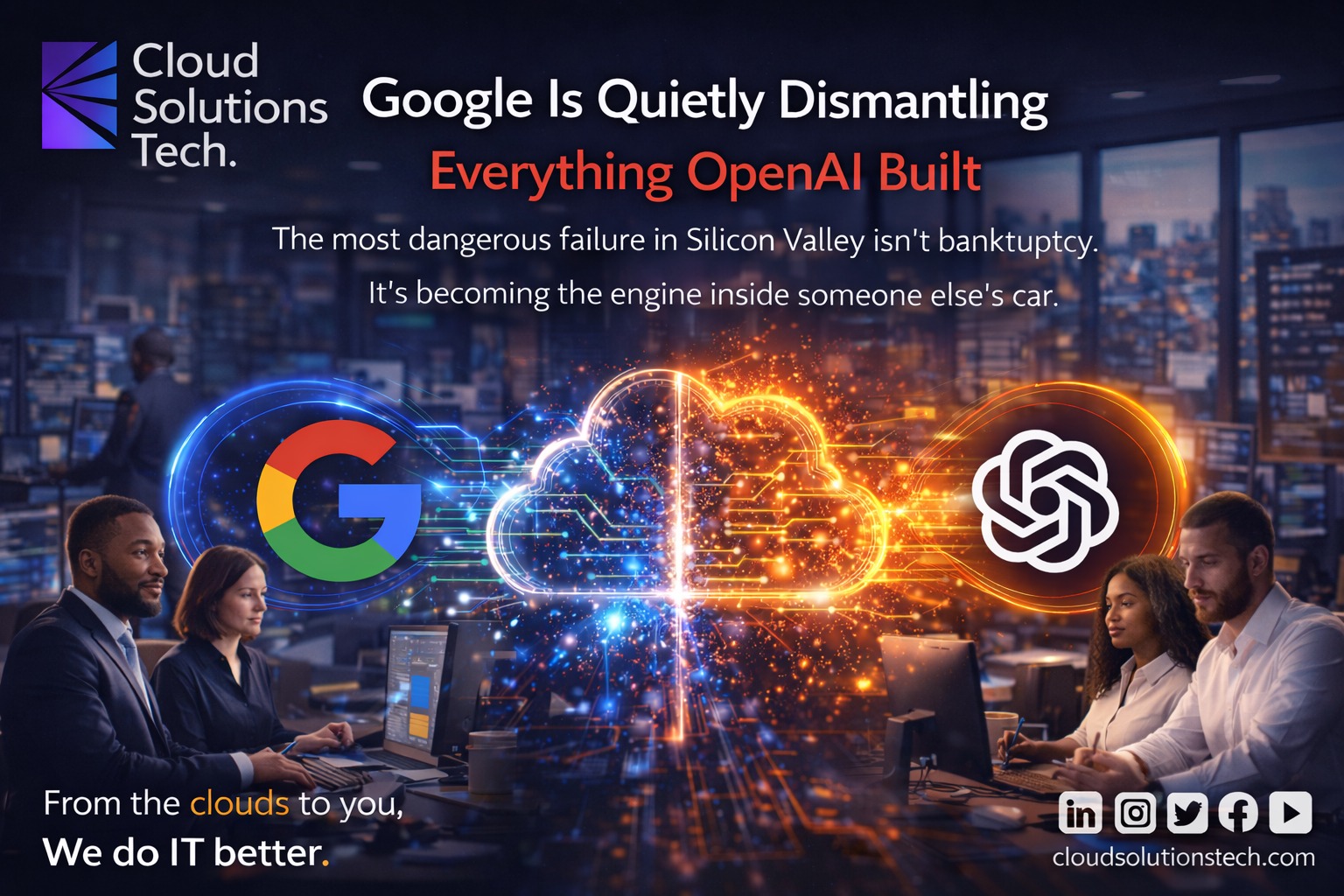
Google vs OpenAI: The Quiet AI Platform War That Could Reshape the Internet
In technology, disruption rarely looks like collapse.
The most dangerous outcome for a pioneer is something far subtler:
becoming the engine inside someone else’s car.
That possibility is beginning to surface in the evolving rivalry between Google and OpenAI, two companies shaping the future of artificial intelligence.
While OpenAI sparked the generative AI revolution with ChatGPT, Google is quietly building something potentially more powerful: the infrastructure layer for AI itself.
And in the long run, platforms usually win.
The Shift From AI Tools to AI Platforms
When ChatGPT launched, it demonstrated what modern generative AI could do. Millions of users suddenly experienced conversational AI capable of writing code, generating content, and answering complex questions.
But the AI industry is now shifting away from standalone tools toward deeply integrated AI ecosystems.
Google is embedding AI directly into:
- Search
- Android
- Chrome
- Google Workspace
- Cloud infrastructure
- Enterprise development platforms
Instead of asking users to visit a chatbot, Google is working to make AI invisible, embedded everywhere.That is a fundamentally different strategy.
Why This Matters for the AI Economy
The real battleground in AI is not just models.
It is distribution and infrastructure.
History has shown this pattern repeatedly:
- Microsoft dominated software through Windows.
- Apple controls mobile ecosystems through iOS.
- Amazon built cloud dominance through AWS.
In each case, the platform provider ultimately shaped the market.
Google’s advantage lies in three strategic assets:
1. Data Scale
Google processes billions of queries every day. That data continuously improves AI systems and user behavior modeling.
2. Global Infrastructure
Through Google Cloud, the company already operates one of the world’s largest AI compute platforms.
3. Product Integration
By embedding AI inside everyday tools people already use, adoption becomes frictionless.
In other words, Google doesn’t need users to switch products.
It simply upgrades the ones they already use.
What This Means for OpenAI
OpenAI remains one of the most influential AI innovators in the world. Its models have pushed the boundaries of reasoning, multimodal capability, and developer adoption.
But innovation alone does not guarantee platform control.
The long-term challenge is ensuring that OpenAI does not become just a model provider inside someone else’s ecosystem.
We already see early signals of this dynamic:
- AI models being integrated directly into operating systems
- Cloud providers offering native AI development environments
- Enterprise tools embedding generative AI features
As AI becomes a core operating layer of software, ownership of the platform becomes the decisive advantage.
The Bigger Strategic Question
The real question isn’t whether Google or OpenAI builds the best AI model.
The real question is:
Who controls the environment where AI lives?
Will AI be delivered primarily through:
- Independent AI platforms
or - Deeply embedded infrastructure ecosystems?
That answer will shape how businesses deploy AI, how developers build applications, and how users interact with technology over the next decade.
The Leadership Takeaway
For organizations investing in AI today, the lesson is clear:
AI strategy should not focus only on models or tools.
It must consider platform alignment.
Companies that build their AI capabilities on scalable infrastructure, secure governance, and flexible integration will have the greatest long-term advantage.
Because the future of AI will not belong to the company with the most powerful model.
It will belong to the company that owns the platform where intelligence runs.
Final Thought
The AI race is no longer just about innovation.
It is about ecosystems, infrastructure, and control of the digital operating layer.
And the quiet platform war now unfolding between Google and OpenAI may determine how the next generation of the internet is built.
From the clouds to you,
We do IT better.