
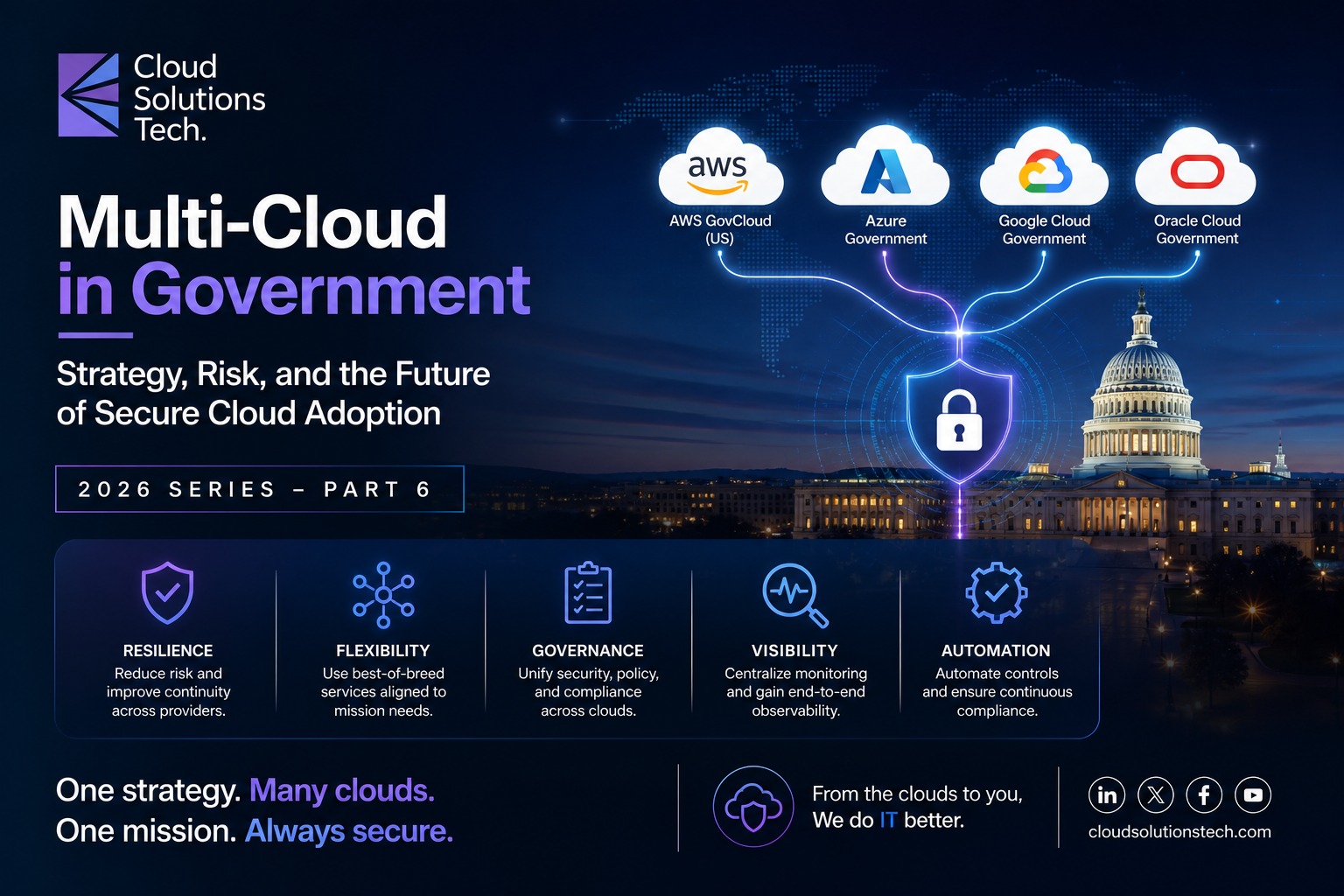
Multi-Cloud in Government.
Strategy, Risk, and the Future of Secure Cloud Adoption (2026 Series – Part 6)
As organizations mature in their cloud journey, a new question is emerging:
- Is one cloud enough?
- In 2026, the answer for many government and regulated organizations is increasingly no.
- The shift toward multi-cloud strategies is accelerating, driven by the need for resilience, flexibility, and strategic advantage.
But in regulated environments, multi-cloud is not just a technical decision. It is a governance, security, and risk management strategy.
What Multi-Cloud Means in Government
Multi-cloud refers to the use of multiple cloud providers such as AWS GovCloud, Azure Government, Google Cloud Government, and Oracle Government Cloud within a single organization.
The objective is not simply diversification.
It is to:
- Reduce dependency on a single provider
- Align workloads with best-fit platforms
- Improve resilience and continuity
- Optimize cost and performance
- Support mission-specific requirements
However, in government environments, multi-cloud must be executed with precision and control.
Why Multi-Cloud Is Gaining Momentum
Several forces are driving adoption:
1. Mission Resilience
Government systems must remain operational under all conditions.
Multi-cloud enables redundancy and failover across providers, reducing the risk of single points of failure.
2. Vendor Flexibility
Different providers offer unique strengths.
Multi-cloud allows organizations to leverage specialized capabilities without being locked into a single ecosystem.
3. Regulatory and Policy Requirements
Certain workloads may require deployment across different environments based on compliance, classification, or agency mandates.
4. Innovation and Competition
Multi-cloud encourages innovation by enabling organizations to adopt emerging technologies across platforms while maintaining competitive leverage.
The Hidden Complexity
While multi-cloud offers strategic benefits, it introduces significant challenges especially in regulated environments.
Security Fragmentation
Each cloud provider has its own security model, tools, and configurations.
Without standardization, organizations risk:
- Inconsistent controls
- Visibility gaps
- Increased attack surface
Identity and Access Management Challenges
Managing identity across multiple platforms can lead to:
- Role sprawl
- Privilege misalignment
- Increased risk of unauthorized access
Compliance Drift
Ensuring consistent adherence to frameworks such as FedRAMP and NIST across multiple clouds is complex.
Without automation, organizations may struggle to maintain continuous compliance.
Operational Overhead
Multi-cloud environments require:
- Skilled teams across platforms
- Integrated monitoring systems
- Coordinated incident response processes
This increases both cost and complexity if not managed effectively.
Key Principles for Successful Multi-Cloud Strategy
Leading organizations approach multi-cloud with discipline, not ambition alone.
1. Standardize Security and Governance
Define a unified security baseline that applies across all cloud environments.
This includes:
- Identity policies
- Encryption standards
- Logging requirements
- Access controls
Consistency is critical.
2. Centralize Visibility
Organizations must establish a single pane of glass for monitoring and security operations.
This enables:
- Real-time threat detection
- Unified logging and analytics
- Coordinated incident response
3. Adopt a Zero Trust Model
Trust should never be assumed across clouds.
Each request, user, and system must be:
- Authenticated
- Authorized
- Continuously verified
4. Automate Compliance
Compliance must be enforced programmatically.
Organizations should:
- Implement policy-as-code
- Continuously validate configurations
- Automate reporting and audit evidence collection
5. Design for Interoperability
Multi-cloud success depends on seamless integration.
This includes:
- Secure data exchange
- API-driven architectures
- Standardized deployment patterns
What Executive Leaders Should Consider
Multi-cloud is not simply a technical initiative, it is a strategic transformation.
Leadership should focus on:
- Clarity of Purpose: Why multi-cloud? Define clear business and mission objectives.
- Risk Management: Understand and proactively address security and compliance risks.
- Talent and Capability: Ensure teams have the skills and tools required to operate across platforms.
- Governance Framework: Establish clear policies, ownership models, and accountability structures.
The Future of Government Cloud
Multi-cloud is shaping the future of government IT.
Organizations are moving toward:
- Hybrid + multi-cloud architectures
- AI-enabled cross-cloud operations
- Unified security and compliance platforms
- Platform engineering for standardized delivery
The goal is not just to use multiple clouds.
It is to operate them as a cohesive, secure, and mission-aligned ecosystem.
Final Takeaway
Multi-cloud offers powerful advantages but only when executed with discipline.
In government and regulated environments, success depends on the ability to:
Standardize security.
Maintain visibility.
Automate compliance.
And align cloud strategy with mission outcomes.
In 2026, multi-cloud is not just an option.
It is a defining capability for organizations building the future of secure digital infrastructure.
What’s Next in This Series
Part 7 (Next Week):
Cloud Security Posture Management (CSPM) in GovCloud — Visibility, Risk, and Continuous Compliance
From the clouds to you,
We do IT better.