
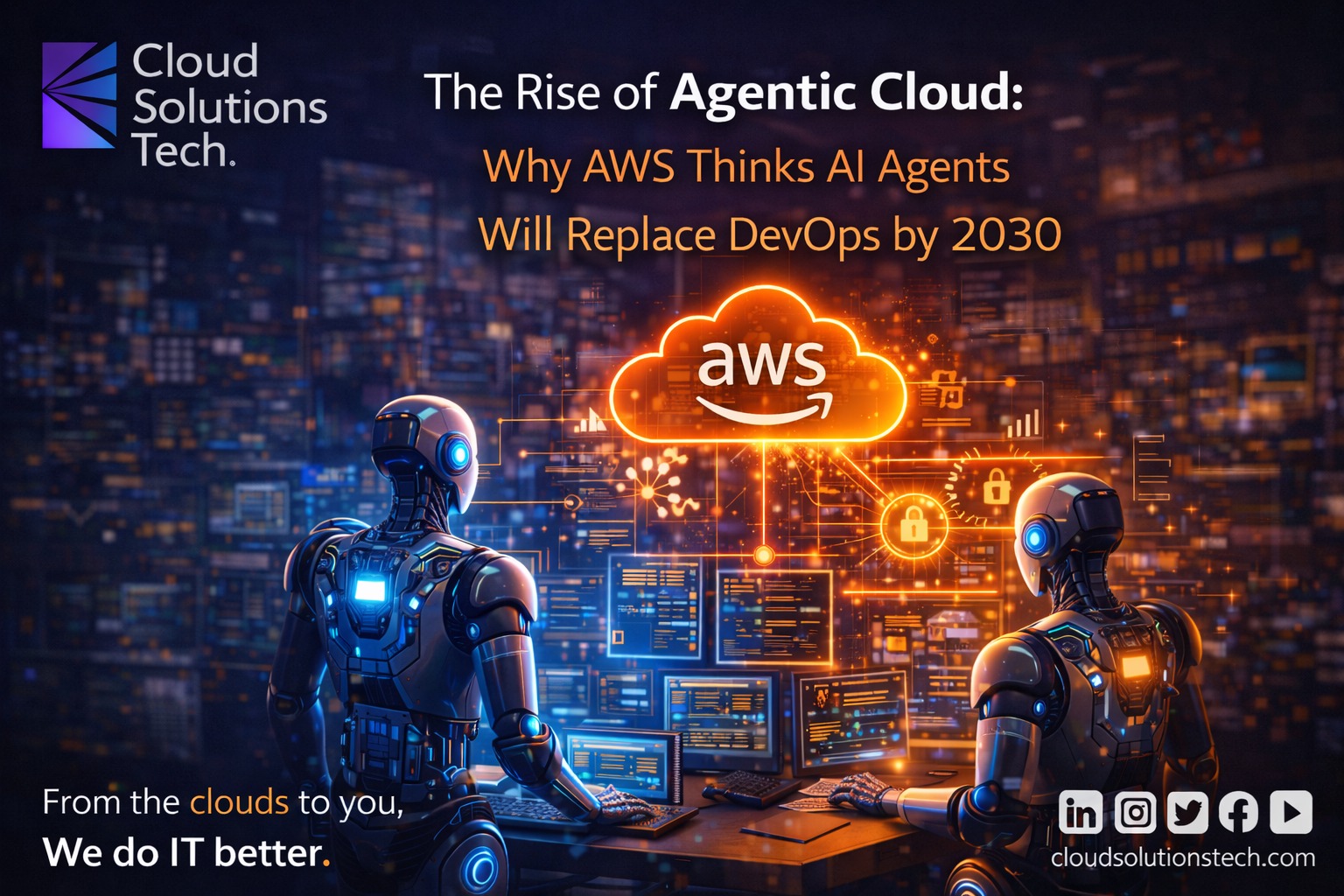
The Rise of Agentic Cloud: Why AWS Believes AI Agents Could Transform DevOps by 2030
The cloud industry is entering a new era where software no longer just runs applications but actively manages itself.
Across the technology landscape, a powerful concept is gaining traction: Agentic AI.
Instead of tools that wait for human instructions, AI agents can observe systems, make decisions, and execute tasks autonomously. Major cloud providers especially AWS are investing heavily in this direction, signaling what could become the next major transformation in cloud operations.
For DevOps teams, this raises an important question:
Are we moving toward a future where AI agents handle much of what DevOps engineers do today?
What Is the Agentic Cloud?
Agentic cloud refers to a cloud environment where AI-powered agents monitor, analyze, and execute operational decisions automatically.
These AI agents operate continuously across infrastructure, applications, and security layers.
Instead of manually reacting to issues, the system can:
- Detect anomalies in real time
- Automatically scale infrastructure
- Patch vulnerabilities
- Optimize costs
- Deploy updates safely
- Resolve incidents before users even notice
In essence, the cloud becomes self-operating infrastructure.
AWS has already introduced early building blocks that point in this direction through services such as:
- Amazon Q for AI-assisted development
- Bedrock Agents for autonomous workflows
- Event-driven automation using Lambda and EventBridge
- AI-powered monitoring and observability tools
Together, these technologies form the foundation of what many experts now call Agentic Cloud Architecture.
Why DevOps Is Being Rethought
DevOps revolutionized software delivery by combining development and operations into automated pipelines.
But the model still requires significant human oversight:
- Engineers monitor dashboards
- Teams respond to alerts
- Operators tune infrastructure
- Security teams manage guardrails
Agentic AI introduces the possibility of automating much of this operational decision-making.
Imagine an AI agent that:
- Detects a traffic spike
- Predicts a capacity bottleneck
- Deploys additional compute resources
- Validates system health
- Optimizes costs after the spike ends
All without human intervention.
This doesn’t eliminate DevOps but it changes the role dramatically.
The New Role of Engineers in an Agentic Cloud
Rather than managing infrastructure manually, engineers will increasingly focus on designing intelligent systems and guardrails.
Future cloud engineers may spend more time:
- Designing AI-driven automation workflows
- Implementing governance and policy frameworks
- Training AI agents for operational decision-making
- Managing AI observability and safety controls
In other words, the role shifts from operators to orchestrators of intelligent infrastructure.
The Security Implications
Autonomous systems introduce powerful capabilities, but they also create new security challenges.
Organizations must ensure AI agents operate within strict governance boundaries.
Key areas of focus will include:
- AI decision auditability
- Guardrails to prevent unintended actions
- Identity and access control for AI agents
- Monitoring automated changes to infrastructure
- Compliance with regulatory frameworks
This is why AI governance and security guardrails are becoming critical pillars of cloud architecture.
What Businesses Should Do Now
The rise of Agentic Cloud does not mean DevOps disappears overnight.
But organizations that prepare early will have a significant advantage.
Technology leaders should begin investing in:
- AI-enabled automation pipelines
- Cloud observability and telemetry
- FinOps and cost optimization intelligence
- AI governance frameworks
- Event-driven architectures
Companies that successfully combine cloud infrastructure, AI automation, and governance will define the next generation of digital operations.
Final Thoughts
Cloud computing has evolved through several phases:
Virtualization → Cloud Infrastructure → DevOps → Automation.
Now the next evolution is emerging:
Agentic Cloud — infrastructure that can think, decide, and act.
By 2030, AI agents may not replace engineers, but they will fundamentally reshape how cloud systems are operated.
And organizations that learn to design intelligent, autonomous cloud platforms will lead the next era of technology innovation.
From the clouds to you,
We do IT better.