
Cloud Computing Trends Businesses Must Understand in 2026
Published by Cloud Solutions Tech (CST)
Weekly IT Intelligence – Monday Edition
Introduction: Cloud Maturity Is the New Goal
Cloud computing has reached a level of maturity where success is no longer defined by simply “moving to the cloud.” In 2026, the organizations getting the most value from cloud are focused on what comes after migration: efficiency, security, resilience, and governance.
Many businesses are now asking the right questions:
- Are we optimizing costs, or just paying cloud bills?
- Are our workloads resilient, or one outage away from major disruption?
- Are we secure and compliant, or exposed through identity gaps and misconfigurations?
- Are teams productive, or slowed down by cloud complexity?
At Cloud Solutions Tech (CST), we see the cloud entering its next phase: cloud as a strategic operating model not just an infrastructure choice. This article breaks down the most important cloud computing trends in 2026, why they matter, and what practical steps organizations can take to stay ahead.
1) Hybrid and Multi-Cloud Become the Default
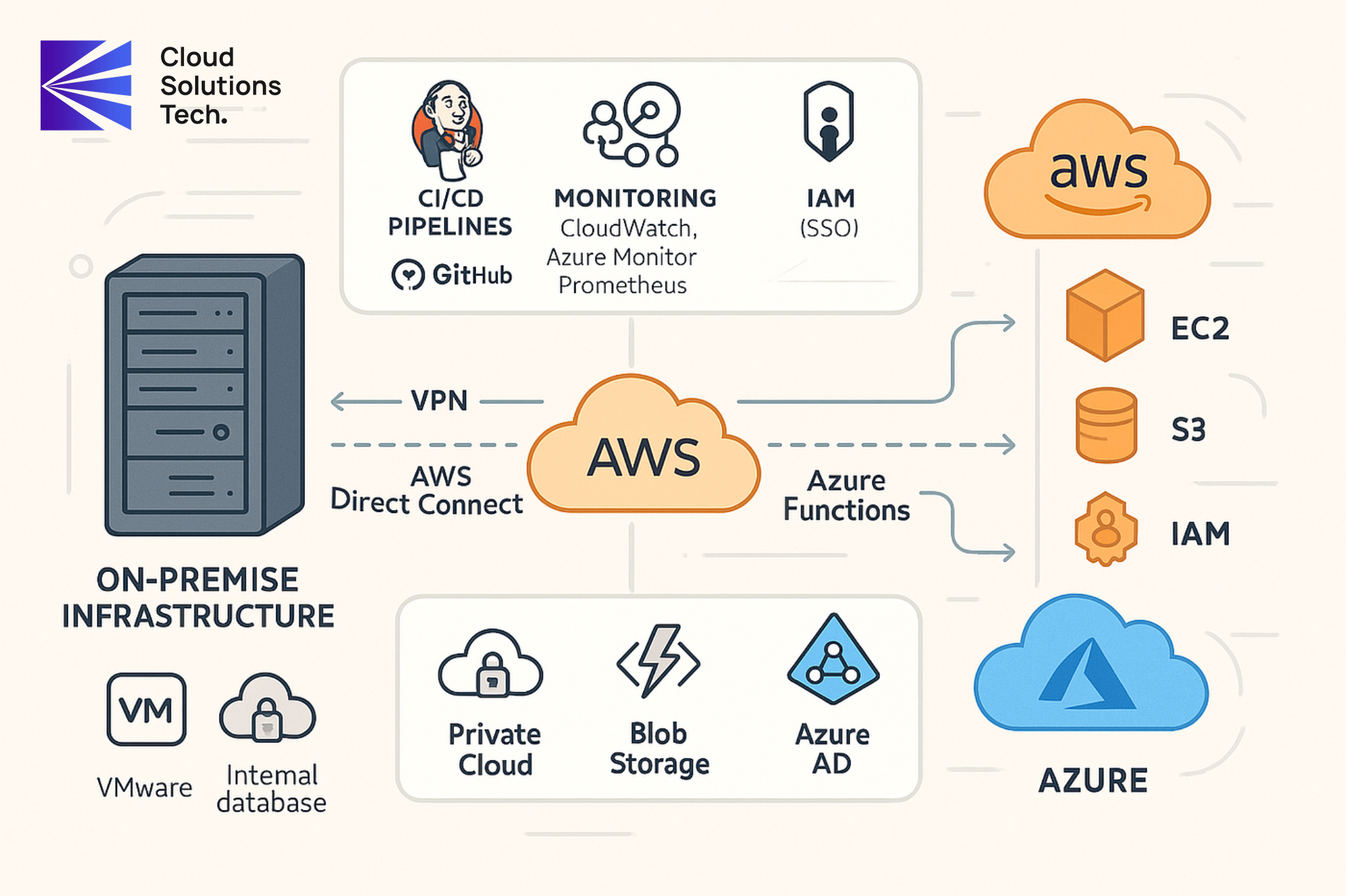
A major shift is happening: many organizations are moving away from “single-cloud dependency.” Instead, they are adopting a combination of hybrid cloud and multi-cloud approaches.
Hybrid cloud: bridging on-prem and cloud
Hybrid cloud typically means integrating on-premises systems (or private cloud) with public cloud services. This remains popular because many organizations still have:
- Legacy applications that can’t be moved quickly
- Data residency requirements
- Specialized workloads (e.g., low-latency systems)
- Long-term investments in data centers
Hybrid cloud allows gradual modernization rather than risky “big bang” migrations.
Multi-cloud: strategic flexibility and resilience
Multi-cloud means using more than one public cloud provider (for example, different providers for different workloads). The main drivers include:
- Reducing vendor lock-in
- Best-of-breed services (choosing the strongest tool per cloud)
- Negotiating power and cost leverage
- Resilience and continuity (less dependency on a single provider)
Industry commentary continues to emphasize hybrid/multi-cloud adoption as a dominant direction for 2026.
The tradeoff: complexity
Hybrid and multi-cloud can unlock flexibility, but they also increase complexity:
- Multiple identity models
- Multiple networking patterns
- Multiple security policies and tooling
- Multiple billing structures and cost allocations
CST Insight:
Hybrid/multi-cloud can be powerful but without strong standards and governance, it can become operational chaos.
2) FinOps Becomes a Core Business Function
Cloud cost has become one of the biggest cloud challenges worldwide. The problem isn’t just that cloud is expensive, it’s that cloud can become expensive quietly, especially when cost visibility is weak.
This is why FinOps (Cloud Financial Management) is no longer “nice to have.” It’s becoming a core capability embedded into engineering and operations teams.
Why cloud costs escalate
Common cost drivers include:
- Overprovisioned compute and storage
- Unused resources (idle instances, unattached volumes, forgotten dev environments)
- Data transfer and inter-region traffic surprises
- Lack of tagging/ownership (nobody knows who owns what)
- Scaling without guardrails
What FinOps looks like in 2026
FinOps isn’t “cutting spend.” It’s building a culture where teams can:
- Measure usage and cost accurately
- Allocate spend to teams/products
Optimize waste continuously - Govern via policies and automation
Key practices include:
- Tagging standards and cost allocation rules
- Budget alerts and anomaly detection
- Rightsizing recommendations and scheduled shutdowns
- Chargeback/showback reporting
- Unit economics (cost per customer, cost per transaction)
CST Insight:
FinOps maturity is the difference between “cloud is too expensive” and “cloud is delivering measurable ROI.”
3) Platform Engineering and Cloud Standardization Rise
As cloud environments grow, teams often face “tool sprawl” and inconsistent deployment approaches. One team uses one pattern, another team uses something else and security/operations teams struggle to manage it all.
That’s why platform engineering continues to rise: organizations are building internal platforms (sometimes called “golden paths”) that standardize:
- CI/CD templates
- Infrastructure as Code modules
- Logging/monitoring defaults
- Security controls and guardrails
- Approved service catalogs
This reduces friction for developers and improves compliance and reliability across teams.
Why it matters
Platform engineering helps companies:
- Deliver faster without sacrificing security
- Reduce misconfigurations
- Improve onboarding and consistency
- Scale cloud operations without scaling headcount at the same rate
Analogy:
Platform engineering is like building well-marked highways with guardrails, developers can drive faster and safer without building a new road every time.
4) Serverless and Automation Continue to Expand
Serverless computing keeps growing because it reduces operational burden and improves scalability. Instead of managing servers, teams focus on:
- Application logic
- Event-driven workflows
- API development
- Integration patterns
Serverless is especially attractive for:
- APIs and microservices
- Scheduled jobs and automation tasks
- Event-driven data pipelines
- Backend services for web/mobile apps
Why automation is accelerating
Automation is the only sustainable way to manage cloud scale. In 2026, winning cloud teams are investing in:
- Infrastructure as Code (IaC) for repeatable deployments
- Policy-as-code for security controls
- Automated patching and image pipelines
- Continuous compliance checks
- Self-healing and auto-remediation
CST Insight:
The cloud rewards automation. The more environments you have, the more you must automate or the cloud becomes unmanageable.
5) Cloud Security Shifts to Identity, Zero Trust, and DevSecOps
Security remains one of the most important cloud trends but it has changed shape. In the cloud, the perimeter is less relevant. The new perimeter is identity.
Identity becomes the core security control
Modern cloud security emphasizes:
- Strong IAM policies
- Least privilege access
- MFA everywhere (especially privileged users)
- Secrets management
- Just-in-time access for administrators
Zero Trust security continues to expand
Zero Trust is built on a simple principle: never trust, always verify. In cloud, this means:
- Continuous authentication and authorization
- Micro-segmentation and network controls
- Continuous monitoring and behavioral detection
Many 2026 trend analyses highlight Zero Trust and cloud-native security as key themes.
DevSecOps becomes the standard
Security is increasingly integrated into:
- CI pipelines (code scanning, dependency checks)
- Container/image scanning
- IaC scanning (misconfiguration prevention)
- Runtime threat detection
CST Insight:
In 2026, “security after deployment” is too late. Security must be built into the delivery pipeline.
6) Observability and Reliability Become Non-Negotiable
With more distributed systems, more services, and more APIs, cloud operations become harder to manage. This is why observability is a major trend: companies want deep visibility into:
- Performance
- Reliability
- Latency and user experience
- Errors and failures
- Resource utilization
- Security signals
What modern observability includes
- Metrics (health and performance)
- Logs (system events and debugging)
- Traces (end-to-end request tracking)
- SLIs/SLOs (measurable reliability goals)
Organizations are moving from “monitoring dashboards” to operational intelligence, where systems not only report issues, but help teams understand root causes faster.
7) Cloud Becomes the Engine Behind AI Workloads
A major reason cloud remains central in 2026 is AI. AI workloads require massive compute and specialized infrastructure (often GPUs), and cloud platforms are becoming the default place to run and scale them.
For many businesses, AI success will depend on cloud capabilities such as:
- Scalable data storage and pipelines
- Secure model hosting and inference environments
- Cost-performance optimization for compute-heavy workloads
- Governance and monitoring for AI systems
CST Insight:
AI is accelerating cloud adoption, and cloud is enabling AI adoption. In 2026, these two strategies are tightly linked.
Practical Checklist: How Businesses Can Win with Cloud in 2026
To stay competitive, organizations should focus on the following action areas:
1) Build a cloud operating model
Define standards for:
- Architecture patterns
- Security controls
- Deployment and CI/CD workflows
- Observability requirements
2) Treat costs as an engineering responsibility
- Enforce tagging and ownership
- Use budgets and anomaly detection
- Make FinOps part of delivery culture
3) Standardize through platform engineering
- Create reusable templates and golden paths
- Reduce tool sprawl and inconsistency
4) Invest in security and resilience early
- Zero Trust principles
- Identity-first controls
- Regular backup/DR testing
5) Automate everything that repeats
- IaC
- security scanning
- compliance checks
- patching and image pipelines
CST Perspective: Cloud Success Is Management, Not Migration
Cloud maturity in 2026 is not defined by how quickly you moved workloads. It’s defined by how well you run what you built day after day, under real business pressure.
Cloud success is about:
- Operational excellence
- Cost discipline (FinOps)
- Security by design (DevSecOps/Zero Trust)
- Reliability through observability and resilience
- Standardization at scale (platform engineering)
When these pillars come together, cloud becomes what it was always meant to be: a platform for speed, innovation, and business growth, not just infrastructure.