
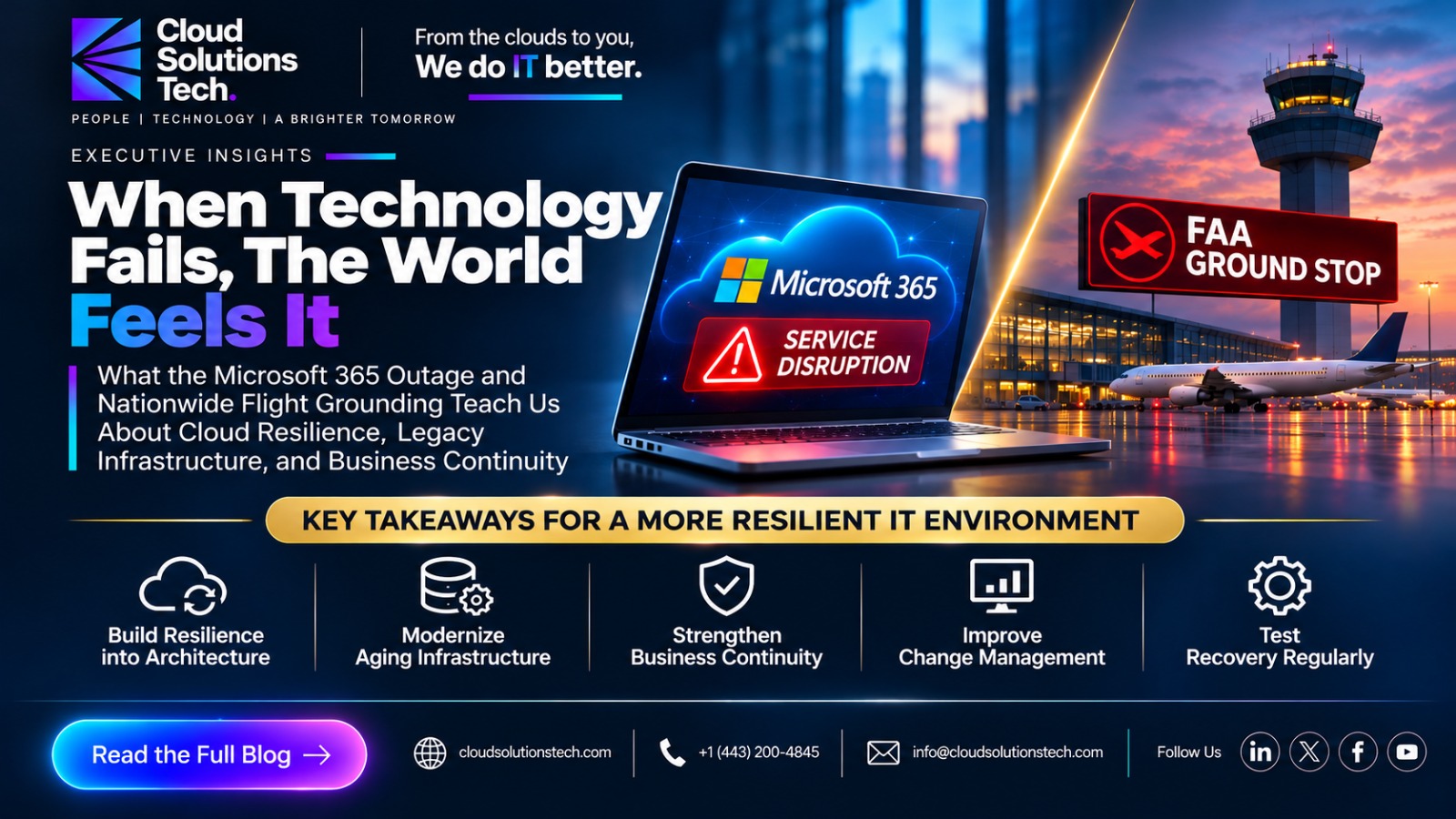
When Technology Fails, The World Feels It
What the Microsoft 365 Outage and Nationwide FAA Ground Stop Teach Us About Cloud Resilience, Legacy Infrastructure, and Business Continuity
Cloud Solutions Tech | Executive Insights Series
Published: Monday, November 16, 2026
Reading Time: Approximately 3 Minutes
When Critical Technology Fails, the Impact Goes Beyond IT
What happens when the technology powering businesses, government operations, and essential services suddenly becomes unavailable?
Last week, the world witnessed two major disruptions that demonstrated how deeply modern society depends on reliable digital infrastructure.
On November 12, 2026, a widespread Microsoft 365 outage disrupted essential workplace services, including Outlook, Teams, and Copilot.
The following day, November 13, a separate telecommunications failure affecting the Federal Aviation Administration (FAA) resulted in a nationwide ground stop across the United States.
Although unrelated, both incidents revealed a critical reality:
Technology failures are no longer isolated IT problems. They can rapidly become business continuity, economic, and public safety challenges.
These events should prompt every technology leader to reconsider how their organization approaches infrastructure resilience.
1. The Microsoft 365 Outage: When Cloud Dependency Becomes Business Risk
Microsoft 365 has become an essential productivity platform for organizations worldwide.
Businesses rely on its services for email, collaboration, document management, and daily operations.
However, beginning November 12, a significant service disruption affected Microsoft 365 users across multiple regions.
The outage impacted Exchange Online and features of several connected services, including Outlook, Teams, SharePoint, and Copilot.
Microsoft’s investigation identified infrastructure instability involving server availability, resource utilization, and connection-processing capacity.
The company subsequently restored affected services and reported no evidence of malicious activity.
The lesson: Cloud adoption does not eliminate operational risk. It changes where that risk resides.
Even organizations using highly available cloud platforms must prepare for service-provider disruptions.
Source: Reuters, November 12–14, 2026; SecurityWeek, November 12–13, 2026.
2. The FAA Ground Stop: The Hidden Risk of Legacy Infrastructure
On November 13, 2026, the FAA issued a nationwide ground stop following telecommunications instability affecting air traffic control operations.
According to the FAA, excessive network traffic destabilized legacy telecommunications equipment, disrupting aircraft communications and radar feeds.
The instability affected 17 of the FAA’s 22 Air Route Traffic Control Centers.
The agency reported approximately 1,000 connection attempts every four to five seconds during the disruption.
Flights resumed after the affected network components were isolated and system stability was verified.
The FAA stated that the available evidence did not indicate a cyberattack.
This incident exposed a significant challenge facing organizations across industries:
Modern digital operations are often built on infrastructure that was never designed for today’s scale, complexity, or connectivity requirements.
Legacy modernization must therefore become a strategic investment in reliability, security, and operational continuity.
Source: Federal Aviation Administration, November 15, 2026; U.S. Department of Transportation, November 14, 2026.
3. The Bigger Threat: Hidden Dependencies and Single Points of Failure
Modern enterprise infrastructure is highly interconnected.
A typical digital environment may depend on:
Cloud Platforms → Networks → Identity Services → Applications → APIs → Business Operations
When a critical dependency fails, the resulting disruption can extend across multiple systems.
An email outage can interrupt business approvals.
An identity-service failure can prevent access to otherwise healthy applications.
A network configuration problem can affect multiple downstream services.
A failure in legacy infrastructure can disrupt operations far beyond its original location.
The greatest operational risk is not necessarily the initial failure. It is the cascading impact across dependent systems.
This is why organizations need comprehensive dependency mapping, fault isolation, and tested recovery capabilities.
4. Five Critical Lessons for Technology Leaders
1. Build Resilience into Architecture
Organizations should design critical systems with redundancy, fault isolation, and recovery capabilities.
High availability must be validated against realistic failure scenarios rather than assumed from cloud adoption alone.
2. Modernize Aging Infrastructure
Legacy systems can introduce operational risks through outdated protocols, unsupported components, and complex dependencies.
Modernization should prioritize reliability, compatibility, security, and maintainability.
3. Strengthen Disaster Recovery and Business Continuity
Critical services need clearly defined Recovery Time Objectives (RTOs) and Recovery Point Objectives (RPOs).
Organizations must also establish alternative communication and operational procedures when external providers become unavailable.
4. Improve Change Management and Observability
Infrastructure changes should include impact assessments, predeployment validation, monitoring, rollback procedures, and post-change verification.
A change is not successful simply because it was deployed. It must also preserve production stability.
5. Test Recovery Before an Incident
Disaster recovery plans must be exercised regularly.
Failover simulations, incident-response exercises, dependency testing, and recovery validation help organizations identify weaknesses before an actual outage occurs.
5. The Future of Enterprise IT: Resilience by Design
As organizations accelerate cloud adoption, AI integration, automation, and digital transformation, technology dependencies will continue to grow.
The next generation of enterprise architecture must prioritize five essential capabilities:
Availability | Reliability | Security | Observability | Recoverability
Cloud Engineering, DevSecOps, Site Reliability Engineering, Cybersecurity, and Business Continuity teams must collaborate to strengthen operational resilience.
The objective is not to guarantee that technology will never fail.
The objective is to ensure that critical business operations can withstand disruption, recover effectively, and maintain customer trust.
Final Takeaway: Resilience Is a Business Requirement
The Microsoft 365 outage and FAA ground stop serve as important reminders that even sophisticated technology environments can experience unexpected failures.
These incidents raise a fundamental question every organization should be prepared to answer:
If a critical cloud provider, network service, or infrastructure component fails tomorrow, how long can your organization continue operating?
Organizations that invest in resilient architecture, infrastructure modernization, effective change management, and tested recovery strategies will be better positioned to manage future disruptions.
Because in today’s interconnected digital economy:
Reliability is not simply an IT metric.
Resilience is not merely a disaster recovery plan.
And business continuity is not optional.
They are essential foundations for innovation, operational excellence, and long-term customer confidence.
At Cloud Solutions Tech, we believe technology should empower organizations to innovate confidently while maintaining secure, reliable, and resilient operations.
From the clouds to you,
We do IT better.
Supporting Sources & References
The following sources provide additional information about the November 2026 incidents.
Microsoft 365 Service Disruption
- Reuters — Microsoft Restores Outlook and Teams After Global Outage
Published November 12; updated November 14, 2026.
Reports on the widespread disruption affecting Microsoft 365 services, Microsoft’s recovery efforts, and the company’s statements regarding the absence of malicious activity.
- SecurityWeek — Microsoft 365 Outage Disrupts Outlook, Exchange Online and Teams
Published November 12; updated November 13, 2026.
Provides technical details about server health checks, infrastructure resource utilization, secure connection processing, and Microsoft’s remediation efforts.
FAA Nationwide Ground Stop
- Federal Aviation Administration — Nationwide Ground Stop: Questions and Answers
Published November 15, 2026.
Official FAA explanation of the telecommunications instability, affected facilities, safety procedures, network investigation, and restoration of flight operations.
- U.S. Department of Transportation — Update on Restoration of Airspace Following Nationwide Ground Stop
Published November 14, 2026.
Provides government updates on the nationwide ground stop, legacy telecommunications infrastructure, modernization challenges, and restoration activities.
- Reuters — U.S. Flights Resume After Air Traffic Network Failure
Published November 13, 2026.
Independent reporting on the aviation disruption, operational consequences, and investigation into the telecommunications failure.
What’s Next?
Next Week’s Executive Insights
Resilience by Design — Building Cloud Infrastructure That Can Withstand Major Outages
We’ll explore how organizations can strengthen cloud resilience through multi-region architectures, disaster recovery, Infrastructure as Code, automated failover, observability, and continuous resilience testing.