
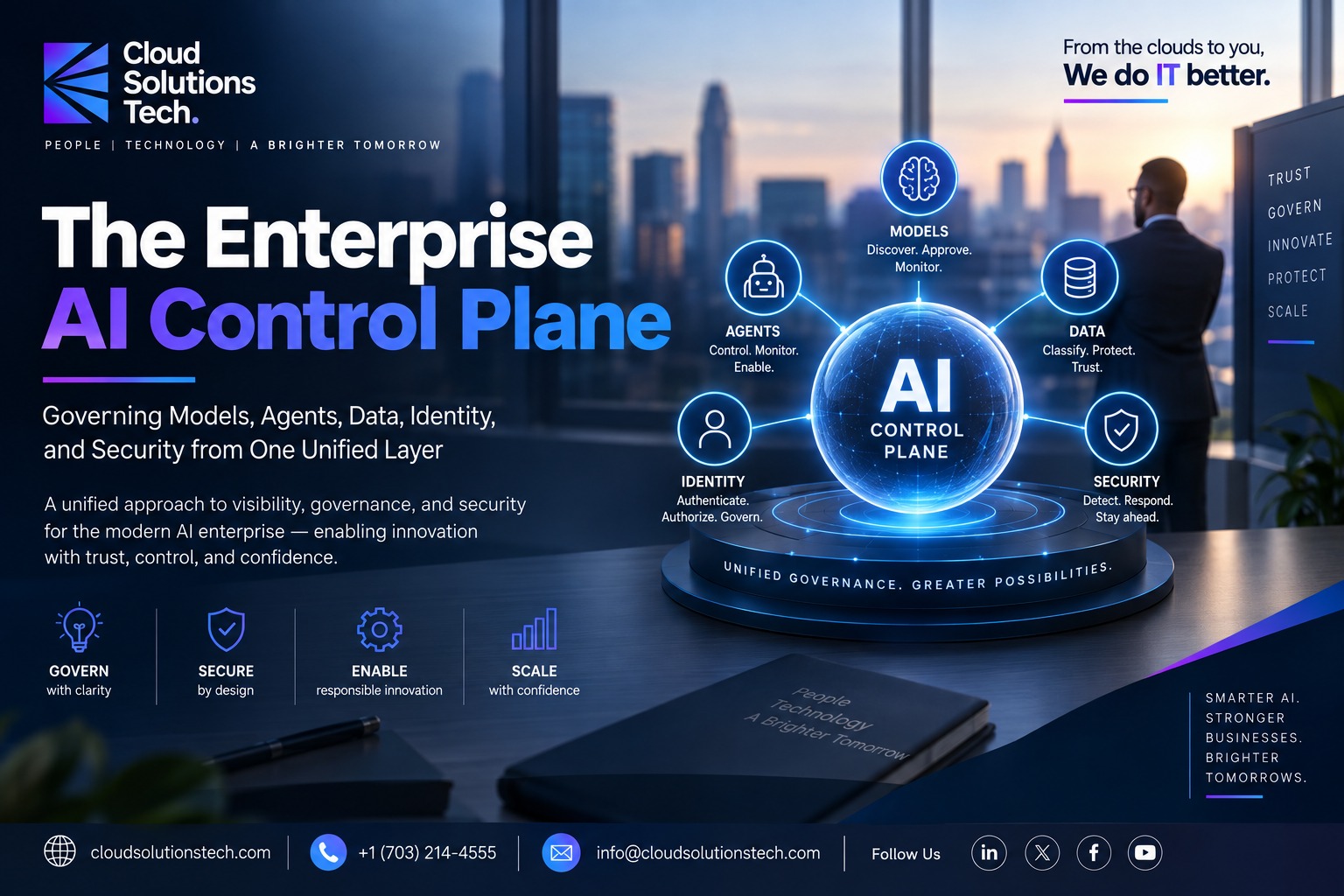
The Enterprise AI Control Plane
Governing Models, Agents, Data, Identity, and Security from One Unified Layer
Cloud Solutions Tech Executive Insights Series
Enterprise AI is moving beyond experimentation.
Organizations are deploying foundation models, copilots, Retrieval-Augmented Generation (RAG), autonomous agents, AI-powered applications, and intelligent workflows across multiple cloud and business environments.
But as adoption expands, a new challenge is emerging:
How do you maintain visibility, security, governance, and control when AI is distributed across the entire enterprise?
Managing every model, agent, dataset, identity, and security policy independently will not scale.
Enterprises increasingly need something more strategic:
An Enterprise AI Control Plane.
A unified governance and security layer that provides centralized visibility and policy enforcement across the organization’s AI ecosystem.
The Problem: Enterprise AI Is Becoming Fragmented
An organization may simultaneously use:
- Multiple foundation models
- Public and private AI platforms
- Custom machine-learning models
- AI agents
- RAG architectures
- Vector databases
- Enterprise datasets
- SaaS-based AI capabilities
- Multi-cloud AI services
- Third-party APIs
Different business units may also deploy AI independently.
Without centralized governance, organizations can quickly lose visibility into:
What AI exists. Who owns it. What data it accesses. What identities it uses. What actions it can perform. Whether it complies with enterprise policy.
This creates a new form of technology sprawl: AI sprawl.
What Is an Enterprise AI Control Plane?
The AI Control Plane is not necessarily a single product.
It is an architectural and governance layer connecting the critical components of enterprise AI.
Think of it as the command center responsible for coordinating:
Models + Agents + Data + Identity + Security + Governance
Rather than allowing each AI workload to operate with isolated controls, the control plane establishes common policies, visibility, accountability, and security boundaries.
The objective is simple: Centralized governance without eliminating distributed innovation.
1. Model Governance
Organizations need visibility into the models operating across their environments.
The control plane should help answer:
- Which models are approved?
- Who owns them?
- Where are they deployed?
- What applications use them?
- What risks have been identified?
- Which versions are currently active?
Organizations can establish an approved model catalog and lifecycle controls covering:
Evaluation → Approval → Deployment → Monitoring → Retirement
This reduces unmanaged and unauthorized AI usage.
2. Agent Governance
AI agents create an even greater governance requirement because they may not simply generate content they may take action.
The control plane should define:
- Which agents are authorized
- Which tools they can invoke
- Which APIs they can access
- What actions they can execute
- Which actions require approval
- How activity is logged and monitored
The goal is controlled autonomy.
An agent should never gain unlimited authority simply because it is intelligent enough to use multiple systems.
3. Data Governance
Enterprise AI depends heavily on data.
A model or agent may interact with:
- Customer records
- Financial information
- Intellectual property
- Internal documents
- Operational databases
- Vector stores
- Knowledge bases
The control plane should enforce policies based on data classification and business context.
For example, an AI agent authorized to access public corporate information should not automatically gain access to confidential financial or personnel data.
AI governance and data governance must therefore operate together.
4. Identity Becomes the Enforcement Layer
Every AI interaction ultimately involves identity.
That identity may belong to:
A Human. A Workload. An Application. An API. An AI Agent.
The AI Control Plane should integrate with enterprise Identity and Access Management to enforce:
- Least privilege
- Just-in-Time access
- Workload identity
- Short-lived credentials
- Conditional authorization
- Privileged access controls
Organizations should be able to determine not only who or what requested access, but also whether that identity should be allowed to perform that specific action at that moment.
5. Security Must Be Built Into the Control Plane
AI security cannot operate as an isolated cybersecurity function.
Security controls should span the entire AI ecosystem.
This includes protection against:
- Prompt injection
- Sensitive data leakage
- Model manipulation
- Excessive agent privileges
- Malicious tool invocation
- Compromised APIs
- AI supply-chain risks
- Unauthorized model usage
Security teams also need centralized telemetry showing how models and agents interact with enterprise systems.
The SOC should be able to investigate AI activity just as it investigates users, applications, endpoints, and cloud workloads.
6. Policy as Code for AI
One of the most powerful capabilities of an AI Control Plane is automated policy enforcement.
Instead of relying entirely on written governance documents, organizations can translate policies into technical controls.
For example:
IF an AI agent requests access to highly sensitive data
THEN require stronger authorization and additional logging.
IF an agent attempts a privileged production change
THEN require human approval.
IF an unapproved model is detected
THEN block deployment and generate a security event.
Governance becomes executable rather than merely documented.
7. Unified AI Observability
Organizations cannot govern what they cannot see.
The control plane should provide visibility into:
Model → Agent → Identity → Prompt/Request → Data → Tool/API → Action → Outcome
This creates an auditable chain of activity.
Security, risk, compliance, and engineering teams can then understand how AI systems behave across the enterprise.
Observability should also help identify unusual behavior, policy violations, excessive privileges, and emerging operational risks.
From AI Sprawl to AI Governance at Scale
Without coordinated governance, organizations may eventually operate hundreds or thousands of models and agents across cloud environments and business applications.
Managing each independently becomes unsustainable.
The Enterprise AI Control Plane creates a common framework where organizations can:
Discover. Govern. Secure. Observe. Authorize. Audit.
This allows innovation to remain distributed while governance remains consistent.
The Future: AI Infrastructure Becomes Policy-Aware
The next generation of enterprise infrastructure will not simply execute workloads.
It will increasingly understand:
Identity. Risk. Data sensitivity. Business context. AI behavior.
Policies will dynamically determine what models and agents can access and what actions they can perform.
This represents an important evolution:
From static AI governance to continuous, context-aware AI governance.
Final Takeaway
The enterprise AI challenge is no longer simply: Which AI model should we use?
The more strategic question is: How do we govern an ecosystem of models, agents, data, identities, and intelligent workloads at enterprise scale?
The answer requires more than individual security tools.
Organizations need a unified architecture that connects:
AI Governance + Identity + Data + Security + Observability + Policy Enforcement.
The Enterprise AI Control Plane provides that foundation.
Because as AI becomes embedded across the organization, the competitive advantage will not belong simply to enterprises that deploy the most AI.
It will belong to those that can innovate rapidly while maintaining visibility, security, control, and trust at scale.
What’s Next?
Next Week:
The AI Trust Fabric — Creating a Zero Trust Architecture for Models, Agents, Data, APIs, and Machine Identities
From the clouds to you,
We do IT better.