
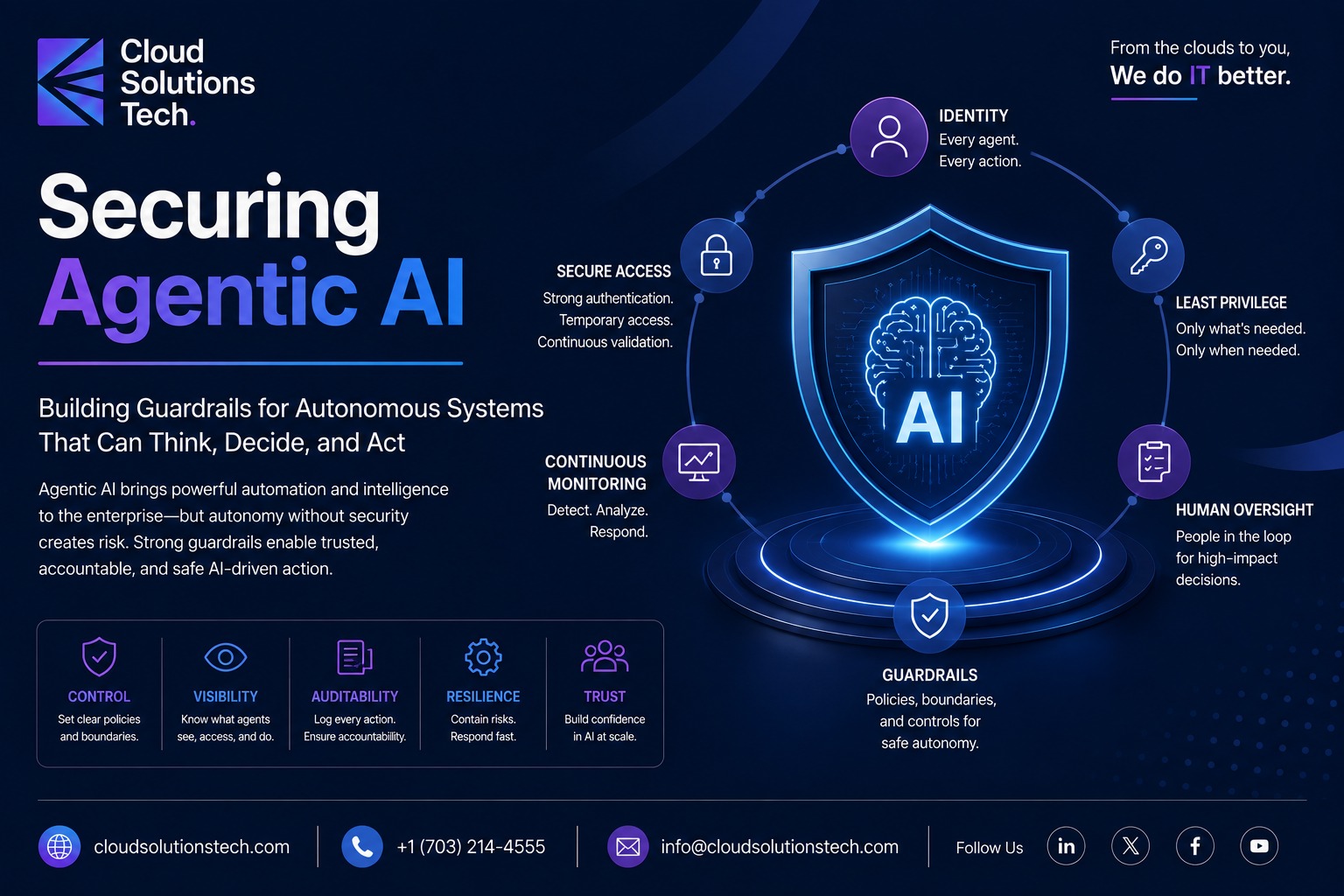
Securing Agentic AI
Building Guardrails for Autonomous Systems That Can Think, Decide, and Act
Cloud Solutions Tech Executive Insights Series
Artificial Intelligence is entering a new phase.
Generative AI gave enterprises systems capable of creating, summarizing, analyzing, and answering questions. Agentic AI goes further.
AI agents can potentially reason through objectives, select tools, retrieve enterprise data, interact with APIs, make decisions, and execute actions across business systems.
An AI assistant may recommend what an employee should do.
An AI agent may actually do it.
That capability creates enormous opportunities for productivity and automation but it also introduces a critical cybersecurity question:
How do organizations safely govern AI systems that can independently think, decide, and act?
The answer is not to eliminate autonomy.
It is to build controlled autonomy through strong security guardrails.
From Generative AI to Agentic AI
Traditional generative AI typically operates within a request-and-response model.
A user provides a prompt, and the model generates an output.
Agentic systems can operate differently.
An AI agent may receive a business objective such as:
“Investigate this security incident and recommend remediation.”
The agent could then:
- Develop a sequence of actions
- Query security platforms
- Examine logs
- Retrieve threat intelligence
- Correlate evidence
- Determine potential impact
- Recommend remediation
- Execute approved actions
This ability to interact with enterprise systems transforms AI from a knowledge tool into a digital actor.
And digital actors require security boundaries.
Why Agentic AI Changes the Risk Model
Traditional application security assumes software executes functionality explicitly designed by developers.
AI agents may dynamically determine how to accomplish an objective.
That introduces new risks.
An attacker may attempt to manipulate an agent through prompt injection, malicious data, compromised tools, excessive permissions, or poisoned external content.
An over-privileged agent could potentially:
- Access sensitive information
- Modify cloud resources
- Send unauthorized communications
- Execute unintended API calls
- Alter business records
- Trigger automated workflows
The more autonomy an agent receives, the more important its security architecture becomes.
The Seven Guardrails for Secure Agentic AI
1. Give Every Agent a Unique Identity
Every enterprise AI agent should have an identifiable and manageable digital identity.
Organizations should always be able to determine:
Which agent performed an action, under whose authority, and for what purpose?
Anonymous autonomous execution should not become an enterprise operating model.
2. Enforce Least Privilege
AI agents should receive only the permissions required to perform their assigned tasks.
A customer-service agent should not automatically have infrastructure administration privileges.
A security investigation agent should not automatically have permission to delete production resources.
Authorization must remain task-specific and tightly scoped.
3. Prefer Temporary Credentials
Long-lived credentials create unnecessary exposure.
Where technically possible, agents should use:
- Short-lived tokens
- Workload identities
- Just-in-Time access
- Dynamic credentials
Permissions should exist only for as long as the task requires them.
4. Control the Tools Agents Can Use
An agent’s power is heavily influenced by the tools connected to it.
APIs, databases, browsers, cloud platforms, email systems, code repositories, and enterprise applications should not automatically become trusted simply because an agent can access them.
Organizations need policies defining:
Which agent can use which tool, for which purpose, against which resources, and under what conditions.
5. Keep Humans in High-Impact Decisions
Not every action should be autonomous.
High-risk activities may require human authorization before execution, including:
- Deleting production resources
- Changing security policies
- Moving significant funds
- Disabling critical services
- Accessing highly sensitive information
- Modifying privileged identities
A mature architecture determines where AI can recommend, where it can act, and where it must request approval.
6. Treat Agent Inputs as Untrusted
AI agents may consume information from documents, emails, websites, databases, APIs, and other agents.
That information should not automatically be trusted.
Malicious instructions embedded within external content could attempt to influence agent behavior.
Organizations therefore need defenses against:
- Prompt injection
- Data poisoning
- Malicious tool output
- Unauthorized instructions
- Sensitive information leakage
Zero Trust must extend beyond users and networks to the information influencing AI decisions.
7. Log Every Significant Action
Autonomous systems must be observable.
Organizations should capture sufficient telemetry to understand:
- Which agent initiated an action
- What identity it used
- What information influenced the decision
- Which tool was invoked
- What resource was accessed
- What action occurred
- Whether human approval was involved
- What the outcome was
Without auditability, autonomous AI becomes difficult to govern and investigate.
Zero Trust Meets Agentic AI
Zero Trust provides an important architectural principle for agent security:
Never trust implicitly. Verify continuously.
Every significant agent action should be evaluated using context such as:
Agent Identity + User Authority + Requested Action + Resource + Data Sensitivity + Risk + Policy
An authenticated agent should not automatically be trusted to perform every action available to it.
Authentication establishes identity.
Authorization determines what that identity is allowed to do.
That distinction becomes critical in agentic environments.
Build an Agentic AI Kill Switch
Organizations should also prepare for situations where an agent behaves unexpectedly.
Security teams need the ability to:
- Revoke agent credentials
- Terminate active sessions
- Disable tool access
- Block API calls
- Suspend workflows
- Roll back supported changes
- Isolate compromised components
Autonomy without the ability to intervene creates operational risk.
Enterprises need both an accelerator and a brake.
Secure the Entire Agent Lifecycle
Agent security should begin before deployment.
A secure lifecycle should include:
Design → Build → Test → Approve → Deploy → Monitor → Update → Retire
Before production deployment, organizations should test agents for:
- Prompt injection resistance
- Excessive permissions
- Unsafe tool invocation
- Data leakage
- Unexpected behavior
- Policy violations
Security should become part of AgentOps and DevSecOps, not an afterthought.
Governance Must Match Autonomy
A useful principle for enterprise leaders is simple:
The greater the autonomy, the stronger the governance should be.
An AI system that summarizes documents does not carry the same risk as an agent capable of modifying production infrastructure.
Organizations should classify agents according to their:
- Data access
- Privilege level
- Business impact
- External connectivity
- Decision authority
- Ability to execute actions
Higher-risk agents should receive stronger controls, monitoring, testing, and human oversight.
The Goal Is Controlled Autonomy
Organizations should not view security as the enemy of autonomous AI.
Strong guardrails can actually make broader adoption possible.
When enterprises establish trusted identities, least privilege, secure tool access, human approval boundaries, continuous monitoring, and clear governance, teams can deploy agents with greater confidence.
The objective is not:
Maximum autonomy.
It is:
Maximum business value within acceptable risk.
Final Takeaway
Agentic AI represents one of the most significant shifts in enterprise technology.
AI systems are evolving from tools that generate information into systems capable of taking action.
That makes security, identity, governance, and accountability fundamental architectural requirements.
Enterprises preparing for agentic AI should establish a clear foundation:
- Identify every agent.
- Grant least privilege.
- Use temporary access.
- Control tools and APIs.
- Treat inputs as untrusted.
- Require human approval for high-impact actions.
- Monitor continuously.
- Maintain the ability to stop autonomous execution.
The future enterprise may contain thousands of intelligent agents working alongside people and machines.
The organizations that succeed will not be those that give AI unlimited freedom.
They will be those that master secure, governed, and accountable autonomy.
What’s Next?
Next Week:
The Enterprise AI Control Plane — Governing Models, Agents, Data, Identity, and Security from One Unified Layer
From the clouds to you,