
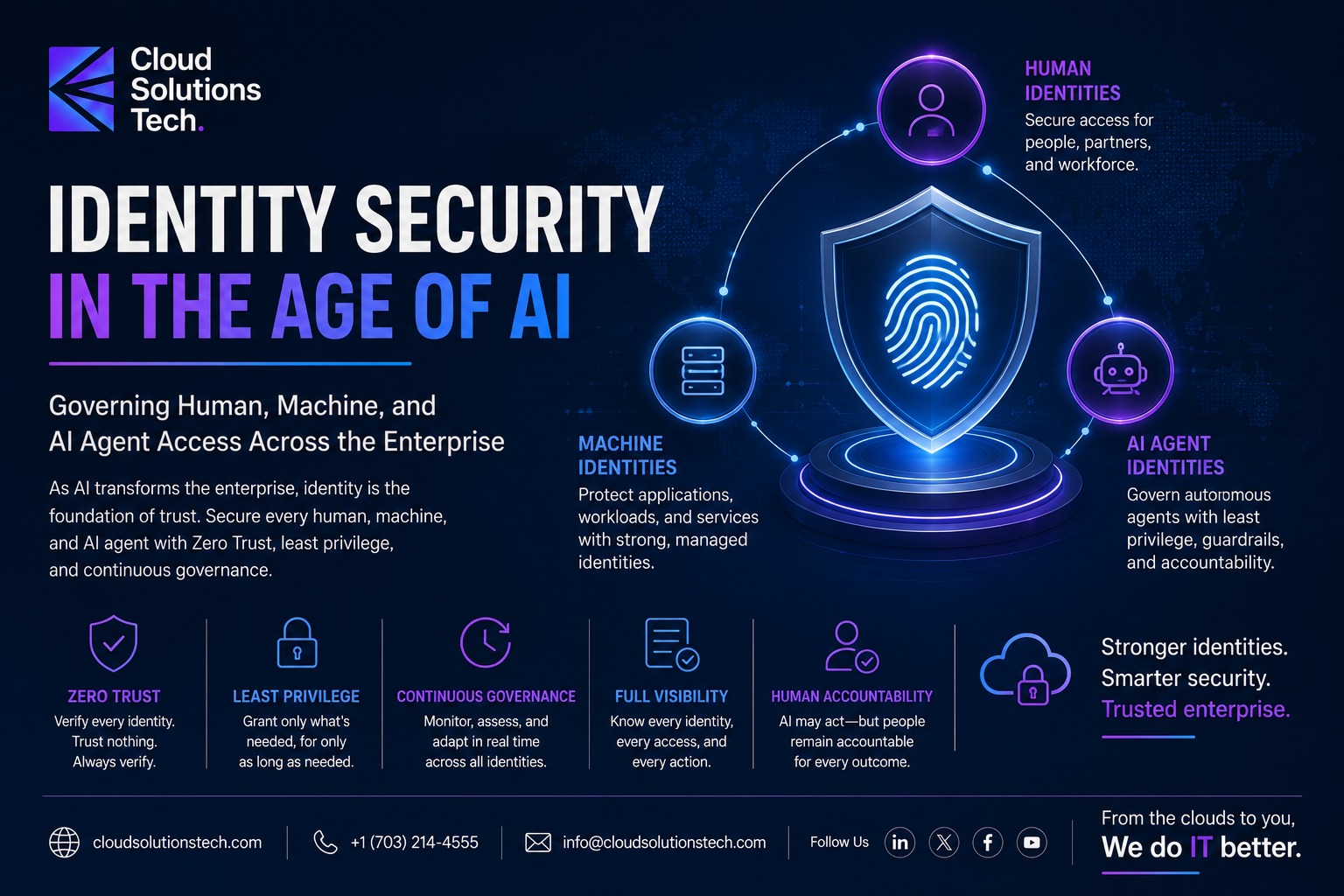
Identity Security in the Age of AI
Governing Human, Machine, and AI Agent Access Across the Enterprise
Cloud Solutions Tech Executive Insights Series
For decades, enterprise identity security focused primarily on one question:
Who is the user, and what should that person be allowed to access?
Artificial Intelligence is fundamentally changing that equation.
Modern enterprises no longer manage only human identities. Cloud workloads, containers, APIs, service accounts, automation platforms, and increasingly AI agents can authenticate to systems, access sensitive information, invoke APIs, and execute business processes.
The enterprise identity perimeter is therefore expanding.
Organizations must now govern three major identity classes:
Human Identities. Machine Identities. AI Agent Identities.
In the age of AI, identity is becoming one of the most important security control planes in the enterprise.
Identity Is the New Security Perimeter
Traditional cybersecurity relied heavily on network boundaries.
Users and systems inside the corporate network were often considered more trustworthy than those outside it.
Cloud computing, remote work, SaaS, APIs, DevOps, and AI have made that model increasingly obsolete.
Modern organizations operate across:
● Public and private clouds
● SaaS platforms
● APIs
● Kubernetes environments
● CI/CD pipelines
● Data platforms
● AI applications
● Autonomous agents
Security can no longer depend primarily on where something connects from.
Organizations must understand:
- Who or what is requesting access?
- What resource is being requested?
- Why is access required?
- What privileges should be granted?
- How long should those privileges exist?
- That is the foundation of modern identity security.
The Three Identities Enterprises Must Govern
1. Human Identities
Employees, contractors, administrators, developers, vendors, and partners continue to require secure access to enterprise resources.
Organizations should strengthen human identity controls through capabilities such as:
● Multi-Factor Authentication
● Single Sign-On
● Role-Based Access Control
● Privileged Access Management
● Conditional access
● Just-in-Time access
● Continuous authentication
The objective is straightforward:
Give the right person the right access to the right resource for the right amount of time.
2. Machine Identities
Modern enterprises may operate thousands or millions of non-human identities.
These include:
● Service accounts
● Applications
● APIs
● Containers
● Kubernetes workloads
● CI/CD pipelines
● Cloud services
● Infrastructure automation
Machine identities often operate continuously and at enormous scale.
If credentials are poorly managed, excessively privileged, or never rotated, attackers can exploit them to move across enterprise environments.
Organizations should increasingly replace long-lived credentials with:
● Workload identities
● Short-lived tokens
● Managed identities
● Dynamic secrets
● Automated credential rotation
Machine identity security must become a core component of enterprise IAM strategy.
3. AI Agent Identities
AI agents introduce an entirely new identity challenge.
Unlike traditional applications, agents may be capable of reasoning, selecting tools, accessing information, invoking APIs, and executing actions dynamically.
Imagine an enterprise AI agent capable of:
● Reading corporate email
● Querying databases
● Accessing cloud resources
● Creating support tickets
● Generating infrastructure changes
● Reviewing security alerts
● Initiating business workflows
That agent is no longer simply software.
From a security perspective, it has become a digital actor within the enterprise.
And digital actors require identities, permissions, policies, monitoring, and accountability.
The Danger of Over-Privileged AI
One of the greatest risks in agentic AI is excessive privilege.
An AI agent should never receive broad administrative access simply because it needs to complete multiple tasks.
Organizations should apply the same Zero Trust principle used for privileged administrators:
Never trust implicitly. Always verify. Grant only what is necessary.
AI agents should receive:
● Explicit identities
● Least-privilege permissions
● Task-specific authorization
● Time-limited access
● Restricted API scopes
● Controlled tool access
● Complete audit logging
Where possible, privileges should be granted dynamically for the specific task and removed afterward.
Identity Governance Must Become Continuous
Traditional identity governance often relies on periodic access reviews.
That approach becomes increasingly difficult when thousands of machine identities and autonomous agents operate continuously.
Organizations need to move toward continuous identity governance.
Security teams should continuously evaluate:
● Who has access
● What permissions exist
● Whether those permissions are being used
● Whether privilege levels remain appropriate
● Whether unusual behavior is occurring
● Whether access should automatically expire
Identity governance must evolve from periodic certification into continuous risk management.
Zero Trust for Humans, Machines, and AI
Zero Trust becomes even more important in AI-enabled environments.
Every access request should be evaluated using context such as:
Identity + Device/Workload + Resource + Risk + Policy + Business Context
This approach enables organizations to make dynamic authorization decisions rather than relying entirely on static permissions.
For AI agents, organizations may also evaluate:
● Which model is executing
● Which agent initiated the request
● Which tool is being invoked
● What data classification is involved
● What action the agent intends to perform
The result is a much stronger security architecture.
Privileged Access Must Include AI
Privileged Access Management has traditionally focused on administrators and powerful service accounts.
That scope must expand.
An AI agent capable of modifying infrastructure, accessing sensitive databases, changing security policies, or executing financial transactions should be treated as a privileged identity.
Organizations should consider controls such as:
● Approval workflows
● Privileged session monitoring
● Just-in-Time elevation
● Credential vaulting
● Segregation of duties
● Command restrictions
● Emergency revocation
Autonomous capability should never mean unlimited authority.
Visibility Is Critical
You cannot secure identities you cannot see.
Organizations need comprehensive inventories covering:
Humans → Applications → Workloads → Service Accounts → APIs → AI Agents
Security teams should understand relationships between these identities and enterprise resources.
For example:
AI Agent → API → Application → Database → Sensitive Data
Mapping these relationships helps organizations identify excessive privileges and potential attack paths before adversaries exploit them.
Human Accountability Must Remain
AI agents may perform actions independently, but organizations still require clear accountability.
Every significant AI-generated action should be attributable to:
● A specific agent
● An authenticated identity
● An approved business purpose
● A defined authorization policy
● An accountable human or organizational owner
Organizations should always be able to answer:
Which agent performed this action, under whose authority, using which permissions, and why?
If that cannot be determined, governance is incomplete.
The Future of Enterprise IAM
Enterprise IAM is evolving beyond traditional workforce identity management.
The next generation of identity architecture will increasingly manage:
Human Identity + Machine Identity + AI Identity
Organizations will require unified visibility, dynamic authorization, automated lifecycle management, continuous risk assessment, and privileged access controls across all three.
Identity security will therefore become much more than an authentication function.
It will become the authorization and governance fabric connecting the intelligent enterprise.
Final Takeaway
Artificial Intelligence is creating a new generation of digital workers capable of accessing information, interacting with applications, and executing increasingly complex tasks.
That creates extraordinary opportunities but also new security responsibilities.
Organizations must ensure that every human, machine, and AI agent operates under clearly defined identity and access controls.
The principles remain powerful:
- Verify every identity.
- Grant least privilege.
- Use temporary access whenever possible.
- Monitor continuously.
- Protect privileged identities.
- Maintain human accountability.
- In the age of AI, the question is no longer simply:
“Who has access?”
The more important question is:
“Who or what has access, what can it do, and should it still have that privilege right now?”
Organizations that can answer that question continuously will be far better prepared to secure the intelligent enterprise.
What’s Next?
Next Week:
Securing Agentic AI — Building Guardrails for Autonomous Systems That Can Think, Decide, and Act
From the clouds to you,
We do IT better.