
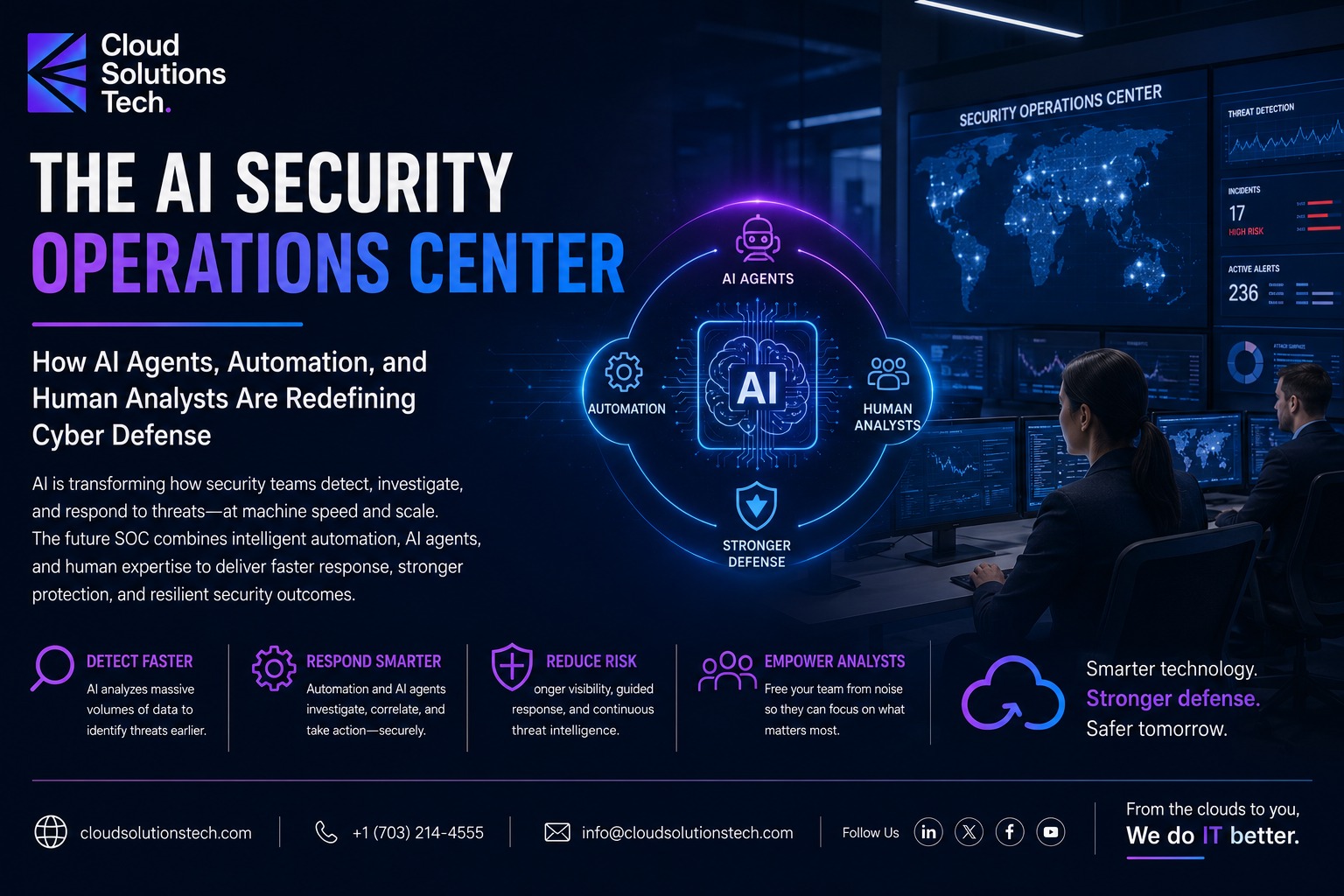
The AI Security Operations Center
How AI Agents, Automation, and Human Analysts Are Redefining Cyber Defense
Cloud Solutions Tech Executive Insights Series
Cybersecurity teams are facing a fundamental challenge: attackers are moving faster than traditional security operations can respond.
Modern enterprises generate enormous volumes of security telemetry across cloud platforms, endpoints, identities, applications, APIs, containers, networks, and increasingly, AI workloads.
Security Operations Centers (SOCs) must analyze thousands or even millions of signals while distinguishing genuine threats from routine activity.
At the same time, adversaries are using automation and Artificial Intelligence to accelerate reconnaissance, phishing, social engineering, malware development, and attack execution.
The traditional SOC must therefore evolve.
Welcome to the era of the AI Security Operations Center, where AI agents, intelligent automation, security platforms, and human analysts work together to detect, investigate, and respond to cyber threats at machine speed.
Why the Traditional SOC Is Evolving
Traditional SOC operations depend heavily on analysts reviewing alerts generated by SIEM, EDR, network security, identity, and cloud security platforms.
The model works but scale has become a major challenge.
Security teams increasingly face:
- Alert fatigue
- Tool fragmentation
- Expanding cloud attack surfaces
- Identity-based attacks
- Sophisticated phishing campaigns
- Shorter attacker dwell times
- Increasingly complex multi-cloud environments
- Shortages of experienced cybersecurity professionals
Adding more dashboards does not necessarily solve the problem.
The next-generation SOC must become intelligent, automated, and context-aware.
AI Agents Enter the Security Operations Center
AI agents represent an important evolution in security automation.
Traditional automation typically follows predefined rules:
If X happens, perform Y.
AI agents can operate differently.
Given appropriate permissions and guardrails, an AI security agent may be able to:
- Analyze an alert
- Gather additional evidence
- Correlate events across multiple systems
- Review threat intelligence
- Investigate suspicious identities
- Summarize findings
- Recommend remediation
- Initiate approved response workflows
Instead of forcing analysts to manually navigate multiple security tools, AI can help assemble the investigation automatically.
The analyst receives context rather than another alert.
From Alert Management to Intelligent Investigation
Consider a suspicious authentication event.
A traditional workflow might require an analyst to manually investigate:
- Identity logs
- Endpoint activity
- IP reputation
- Cloud audit logs
- Recent privilege changes
- Related security alerts
An AI-enabled SOC can orchestrate much of this investigation automatically.
The system could correlate the login with identity behavior, endpoint telemetry, threat intelligence, and cloud activity before presenting the analyst with a summarized risk assessment.
That changes the SOC from an alert-processing center into an intelligence-driven security operation.
Automation Becomes the Response Engine
AI identifies and reasons about threats.
Automation helps execute the response.
Modern security orchestration can automate actions such as:
- Disabling compromised accounts
- Revoking active sessions
- Isolating endpoints
- Blocking malicious IP addresses
- Rotating credentials
- Opening incident tickets
- Collecting forensic evidence
- Triggering additional authentication
- Escalating high-risk incidents
This can significantly reduce Mean Time to Detect (MTTD) and Mean Time to Respond (MTTR).
But not every action should be autonomous.
High-impact remediation should include appropriate approval gates, policy controls, and human oversight.
Humans Remain at the Center
The AI-powered SOC is not a SOC without people.
Human analysts remain critical because cybersecurity requires judgment, context, creativity, and accountability.
AI is particularly effective at:
- Processing large volumes of information
- Detecting patterns
- Correlating telemetry
- Summarizing investigations
- Performing repetitive tasks
Human analysts remain essential for:
- Complex threat hunting
- Incident command
- Business impact assessment
- Strategic decision-making
- Ethical judgment
- Crisis management
The strongest model is therefore not AI versus humans.
It is AI + Automation + Human Expertise.
Identity Becomes a Critical Security Boundary
As organizations deploy more AI agents, another security challenge emerges:
AI agents themselves become identities.
An autonomous agent may have permission to access APIs, cloud resources, databases, security platforms, or enterprise applications.
These machine identities must be governed carefully.
Organizations should apply principles such as:
- Least privilege
- Short-lived credentials
- Strong authentication
- Workload identity
- Just-in-time access
- Segregation of duties
- Continuous authorization
- Complete audit trails
An AI agent should never receive unlimited authority simply because it operates autonomously.
The Architecture of the AI-Powered SOC
The next-generation SOC will increasingly connect several capabilities:
● SIEM and Security Analytics: Centralize and correlate security telemetry.
● SOAR and Automation: Coordinate incident-response workflows.
● AI Agents: Investigate, reason, summarize, and recommend actions.
● Threat Intelligence: Provide context about adversaries, indicators, and attack techniques.
● Cloud and Identity Security: Monitor increasingly distributed enterprise environments.
● AI Security and Governance: Protect models, prompts, agents, and AI workloads themselves.
● Human Analysts: Provide oversight, judgment, escalation, and strategic response.
Together, these components create a security operation capable of responding at greater speed and scale.
Guardrails Are Non-Negotiable
Giving AI the ability to execute cybersecurity actions introduces significant responsibility.
Organizations must establish clear boundaries around autonomous response.
Controls should include:
- Role-based access
- Approval workflows
- Action limits
- Human-in-the-loop escalation
- Audit logging
- Continuous monitoring
- Kill switches and rollback procedures
The goal should be controlled autonomy, not unrestricted autonomy.
From Reactive Defense to Predictive Security
Perhaps the biggest opportunity is moving cybersecurity from reactive response toward proactive defense.
AI can continuously analyze patterns across security environments to identify emerging risks before they become major incidents.
Future SOCs will increasingly focus on:
Detect → Investigate → Predict → Prevent → Respond → Learn
Every incident can improve future detection and response capabilities.
The SOC becomes a continuously learning security ecosystem.
Looking Ahead
The future Security Operations Center will look very different from the SOC of the past.
Analysts will spend less time manually collecting evidence and more time making high-value security decisions.
AI agents will handle increasingly complex investigations.
Automation will execute approved remediation at machine speed.
Security platforms will continuously exchange context.
And human analysts will remain responsible for the decisions where judgment matters most.
This is the emerging model of human-machine cyber defense.
Final Takeaway
Cybersecurity has always been a race between attackers and defenders.
Artificial Intelligence is accelerating both sides.
Organizations can no longer rely exclusively on manual investigation and traditional alert management to defend increasingly complex digital environments.
The modern SOC must combine:
AI Agents. Intelligent Automation. Security Analytics. Zero Trust. Human Expertise.
The organizations that successfully integrate these capabilities will build security operations that are faster, more scalable, more resilient, and better prepared for the threats ahead.
The future of cyber defense will not be fully autonomous.
It will be intelligently orchestrated with AI accelerating the mission and humans remaining accountable for it.
What’s Next?
Next Week:
Identity Security in the Age of AI — Governing Human, Machine, and AI Agent Access Across the Enterprise
From the clouds to you,
We do IT better.