
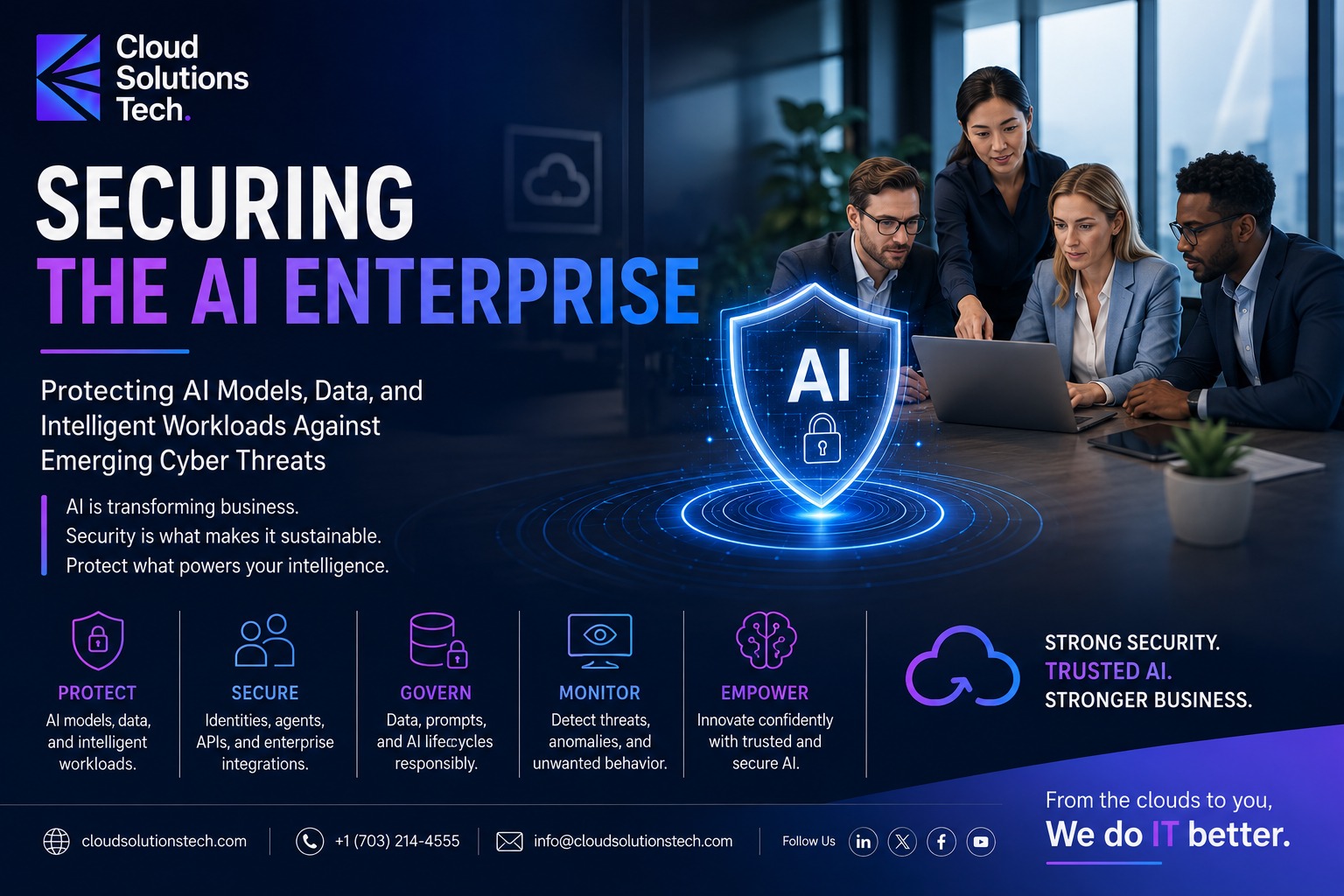
Securing the AI Enterprise
Protecting AI Models, Data, and Intelligent Workloads Against Emerging Cyber Threats
Cloud Solutions Tech Executive Insights Series
Artificial Intelligence is rapidly becoming part of the core infrastructure of modern enterprises.
Organizations are deploying generative AI, copilots, AI agents, predictive models, and intelligent automation across customer service, cybersecurity, software engineering, finance, operations, and executive decision-making.
But as AI becomes more powerful, it also creates a new and rapidly expanding attack surface.
The cybersecurity question is therefore changing.
It is no longer simply:
“How do we use AI securely?”
Organizations must now ask:
“How do we secure an enterprise where AI itself has become critical infrastructure?”
In the AI era, cybersecurity must protect not only applications, networks, and data, but also models, prompts, agents, APIs, vector stores, training pipelines, identities, and the decisions AI systems make.
The AI Attack Surface Is Expanding
Traditional cybersecurity programs were designed primarily around users, endpoints, applications, infrastructure, and networks.
AI introduces additional layers of risk.
An enterprise AI environment may now contain:
- Foundation and proprietary models
- Sensitive training and inference data
- Retrieval-Augmented Generation (RAG) systems
- Vector databases
- AI agents
- Model APIs
- Plugins and external tools
- Machine identities
- MLOps and AI development pipelines
Every component creates potential security exposure.
Attackers no longer need to compromise only the underlying infrastructure. They may attempt to manipulate the intelligence operating on top of it.
Emerging Threats Facing Enterprise AI
Prompt Injection and Manipulation
Generative AI applications can receive malicious instructions designed to override expected behavior, expose information, or manipulate downstream actions.
The risk becomes significantly greater when AI agents have access to enterprise systems or can execute actions autonomously.
Sensitive Data Exposure
AI systems frequently interact with confidential enterprise information.
Poor access controls or inappropriate data handling could expose:
- Customer information
- Intellectual property
- Financial records
- Credentials
- Internal documents
- Regulated data
Data protection must therefore extend across the entire AI lifecycle.
Model and Supply Chain Risk
Enterprises increasingly depend on third-party models, datasets, libraries, APIs, and AI platforms.
A vulnerability or compromise anywhere within this ecosystem can introduce risk into enterprise environments.
AI security must therefore include software and model supply-chain governance.
Data Poisoning and Model Manipulation
Attackers may attempt to corrupt datasets or knowledge sources used by AI systems.
If trusted information is manipulated, AI can generate inaccurate or malicious outputs while appearing legitimate.
Protecting data integrity becomes as important as protecting data confidentiality.
AI Agent Privilege Abuse
AI agents represent one of the most important emerging security considerations.
An agent capable of accessing databases, cloud resources, email, APIs, or business applications should never receive unlimited permissions.
Organizations must treat AI agents as privileged digital identities.
The same principles applied to human administrators should increasingly apply to autonomous systems:
Least privilege. Strong authentication. Limited scope. Continuous monitoring. Complete auditability.
A Zero Trust Approach to AI Security
Zero Trust provides a strong foundation for securing enterprise AI.
The principle remains simple:
Never trust implicitly. Continuously verify.
For AI environments, this means verifying:
- Users
- AI agents
- Applications
- APIs
- Data sources
- Model interactions
- Workload identities
Access should be granted based on identity, context, authorization, and business need not simply because a system operates inside the enterprise boundary.
Protect the Data Behind the Intelligence
AI cannot be secured without securing its data.
Organizations should establish strong controls around:
Data Classification: Understand which information AI systems are permitted to access.
Encryption: Protect sensitive data both at rest and in transit.
Identity and Access Management: Restrict access according to roles, responsibilities, and business requirements.
Data Lineage: Understand where information originated and how it is being used.
Data Loss Prevention: Prevent sensitive information from being exposed through AI-generated responses.
Trusted AI requires trusted and protected data.
Secure AI Across the Lifecycle
AI security cannot begin after deployment.
Security should be integrated throughout the AI lifecycle:
Design → Develop → Train → Test → Deploy → Monitor → Retire
This requires collaboration across:
- Cybersecurity
- Cloud engineering
- DevSecOps
- AI/ML engineering
- Data teams
- Risk and compliance
- Business leadership
The goal is essentially DevSecOps for AI embedding security into AI engineering rather than adding controls after systems reach production.
Continuous AI Monitoring Is Essential
Traditional application monitoring is no longer sufficient.
Organizations need visibility into how AI systems behave after deployment.
Security teams should monitor for:
- Abnormal AI interactions
- Unauthorized model access
- Suspicious API activity
- Unexpected agent behavior
- Sensitive data exposure
- Changes in model performance
- Manipulation attempts
- Excessive permissions
AI observability will increasingly become an important component of the modern Security Operations Center.
Humans Must Remain Accountable
As AI systems become more autonomous, organizations must clearly define where machines can act independently and where human approval remains mandatory.
High-impact actions involving areas such as financial transactions, privileged infrastructure changes, sensitive information, or security policy should have appropriate safeguards.
Autonomy without accountability creates risk.
The objective should therefore be controlled autonomy allowing AI to operate efficiently within clearly defined security boundaries.
Security Can Become an AI Accelerator
Organizations sometimes view cybersecurity controls as barriers to innovation.
The opposite can be true.
When enterprises establish secure AI platforms with approved models, trusted data sources, strong identities, governance controls, and continuous monitoring, teams can innovate faster because the security foundation already exists.
Security becomes an enabler of responsible AI adoption rather than an obstacle.
Looking Ahead
The cybersecurity landscape will continue evolving as AI becomes more deeply integrated into enterprise operations.
Future security programs will increasingly need to protect both human and machine identities, while defending intelligent systems capable of making and executing decisions.
Organizations should prepare for an environment where:
AI protects the enterprise and the enterprise must protect AI.
That dual responsibility will become a defining characteristic of cybersecurity strategy in the years ahead.
Final Takeaway
The AI enterprise introduces extraordinary opportunities, but it also changes the cybersecurity equation.
Organizations must protect more than infrastructure.
They must protect the models, data, agents, identities, integrations, and intelligent workloads that increasingly power the business.
The organizations that succeed will combine AI innovation with:
Zero Trust. Strong identity. Secure data. AI governance. Continuous monitoring. Human accountability.
Because the future of enterprise AI will not be determined solely by who builds the most powerful intelligent systems.
It will also be determined by who can secure them.
What’s Next?
Next Week:
The AI Security Operations Center — How AI Agents, Automation, and Human Analysts Are Redefining Cyber Defense
From the clouds to you,
We do IT better.