
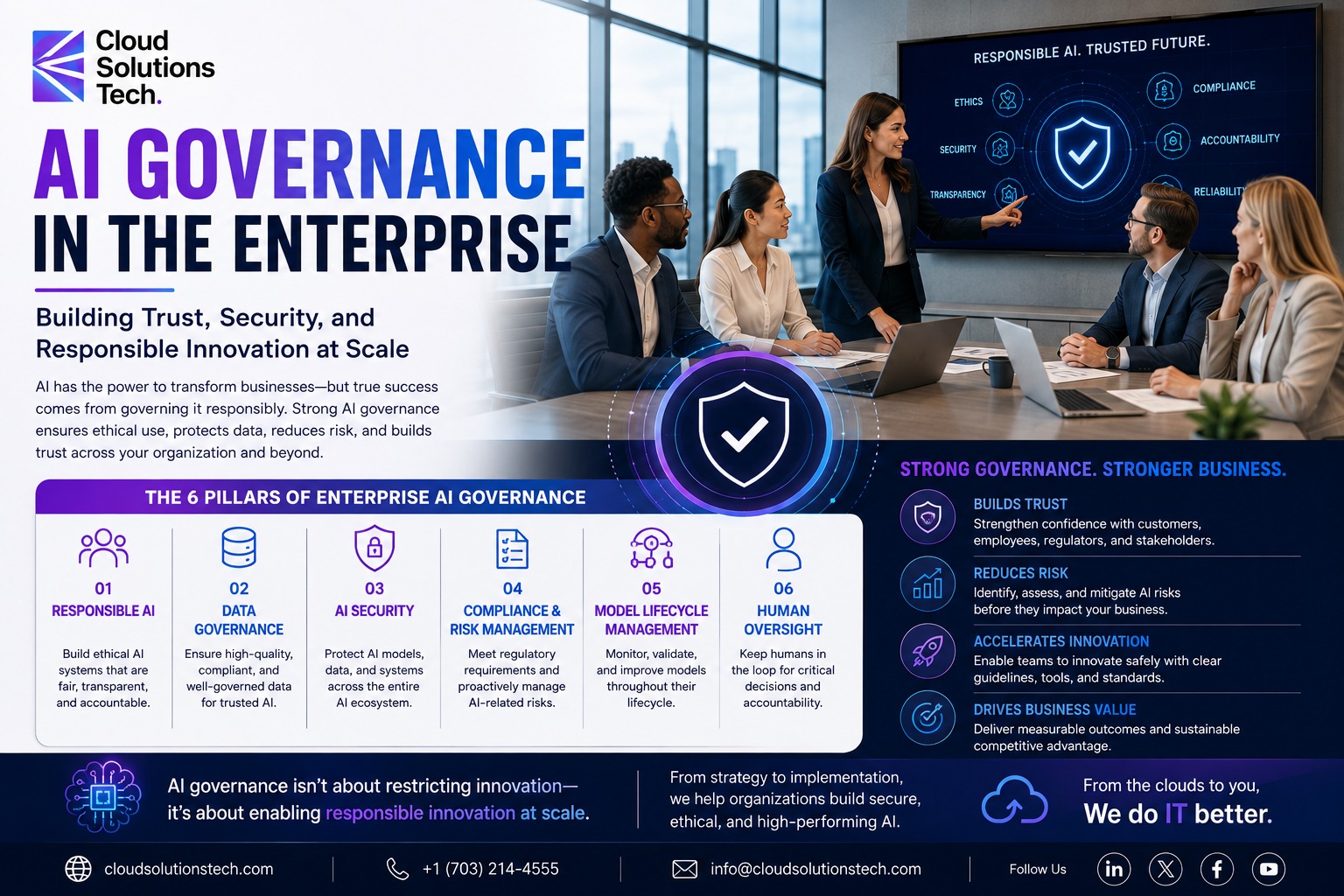
AI Governance in the Enterprise
Building Trust, Security, and Responsible Innovation at Scale
Cloud Solutions Tech Executive Insights Series
Artificial Intelligence is transforming every aspect of modern business from customer engagement and software development to cybersecurity, healthcare, finance, and enterprise operations.
As AI becomes more deeply integrated into business processes, organizations face a new challenge.
How can they innovate rapidly while ensuring AI remains secure, ethical, transparent, and trustworthy?
The answer lies in AI Governance.
In 2026, AI governance is no longer a compliance exercise or an IT responsibility. It has become a strategic business capability that enables organizations to innovate responsibly while maintaining the trust of customers, employees, regulators, and stakeholders.
Organizations that govern AI effectively will not only reduce risk—they will accelerate innovation with confidence.
What Is AI Governance?
AI governance is the framework of policies, processes, technologies, and accountability that ensures Artificial Intelligence systems are developed, deployed, monitored, and managed responsibly.
Its purpose is to ensure AI remains:
- Transparent
- Secure
- Fair
- Explainable
- Compliant
- Reliable
- Aligned with business objectives
Rather than slowing innovation, governance provides the foundation that allows AI initiatives to scale safely across the enterprise.
Why AI Governance Matters More Than Ever
Enterprise AI systems increasingly influence critical decisions, including:
- Customer interactions
- Financial recommendations
- Hiring processes
- Cybersecurity responses
- Fraud detection
- Supply chain optimization
- Executive decision support
Without proper governance, organizations risk:
- Biased outcomes
- Data privacy violations
- Regulatory penalties
- Security vulnerabilities
- Loss of customer trust
- Reputational damage
Strong governance ensures AI remains a strategic asset rather than a business liability.
The Six Pillars of Enterprise AI Governance
1. Responsible AI
Organizations should establish principles that guide how AI is developed and used.
Responsible AI focuses on:
- Fairness
- Accountability
- Transparency
- Human oversight
- Ethical decision-making
These principles should be embedded into every AI initiative from the beginning.
2. Data Governance
AI is only as reliable as the data it learns from.
Organizations should prioritize:
- High-quality datasets
- Data lineage
- Privacy protection
- Data classification
- Access controls
- Regulatory compliance
Trusted data produces trusted AI.
3. AI Security
AI systems introduce new attack surfaces that require dedicated security controls.
Organizations should protect:
- AI models
- Training datasets
- APIs
- Vector databases
- AI agents
- Enterprise integrations
Security practices should include:
- Zero Trust architecture
- Identity and access management
- Encryption
- Continuous monitoring
- Threat detection
- Model integrity validation
Protecting AI is now an essential component of enterprise cybersecurity.
4. Compliance and Risk Management
Governance should ensure AI aligns with applicable regulatory and industry requirements.
Examples include:
- Privacy regulations
- Industry compliance standards
- Internal governance policies
- Responsible AI guidelines
Organizations should continuously assess AI-related risks as technologies evolve.
5. Model Lifecycle Management
AI governance extends throughout the entire model lifecycle.
This includes:
- Model selection
- Validation
- Deployment
- Performance monitoring
- Version control
- Continuous retraining
- Retirement of outdated models
Governance should ensure models remain accurate, secure, and aligned with business objectives over time.
6. Human Oversight
AI should enhance, not replace human judgment.
Organizations should clearly define:
- Which decisions AI can automate
- Which decisions require human approval
- Escalation procedures
- Accountability for AI-generated outcomes
Human oversight remains essential for maintaining trust and ethical responsibility.
Governance Enables Innovation
Many organizations mistakenly believe governance slows innovation.
In reality, governance accelerates responsible innovation.
When employees understand:
- Approved AI tools
- Security expectations
- Governance policies
- Acceptable use guidelines
They can innovate with greater confidence and consistency.
Governance removes uncertainty while reducing operational risk.
The Role of Leadership
Successful AI governance requires executive sponsorship.
Business leaders should establish:
AI Governance Committees
Cross-functional teams representing:
- Executive leadership
- Security
- Legal
- Compliance
- Data management
- Risk
- Technology
- Business operations
Enterprise AI Policies
Clearly documented standards covering:
- Responsible AI
- Data usage
- Privacy
- Model approval
- Vendor risk
- Human oversight
Continuous Education
AI governance is not only about policies.
Employees must understand how to use AI responsibly through ongoing education and awareness.
Technology That Supports AI Governance
Modern governance platforms increasingly integrate:
- AI observability
- Model monitoring
- Data lineage
- Identity management
- Security analytics
- Audit logging
- Policy enforcement
- Compliance reporting
Together, these capabilities provide organizations with continuous visibility into AI operations.
Building Trust at Enterprise Scale
Trust is becoming one of the most valuable competitive advantages in the AI era.
Customers increasingly want to know:
- How AI is making decisions
- How their information is protected
- Whether AI is being used responsibly
Employees want confidence that AI support does not threaten their work.
Executives need assurance that AI investments deliver measurable business value while minimizing organizational risk.
AI governance provides that foundation of trust.
Looking Ahead
As AI agents, autonomous workflows, and enterprise copilots become standard across industries, governance will become even more critical.
Future organizations will increasingly focus on:
- Continuous AI monitoring
- Responsible AI certifications
- AI risk scoring
- Secure AI supply chains
- Explainable AI
- AI compliance automation
Governance will evolve alongside AI innovation, becoming an essential component of every digital transformation strategy.
Final Takeaway
Artificial Intelligence is one of the most transformative technologies of our time.
But sustainable success requires more than powerful models.
It requires trust.
AI governance enables organizations to innovate responsibly by combining strong security, trusted data, ethical principles, regulatory compliance, and human accountability.
The organizations that lead the next decade will not simply build the smartest AI.
They will build the most trusted AI.
Because in the age of intelligent enterprises, trust is the foundation of innovation.
What’s Next?
Next Week:
Securing the AI Enterprise — Protecting AI Models, Data, and Intelligent Workloads Against Emerging Cyber Threats
From the clouds to you,
We do IT better.