
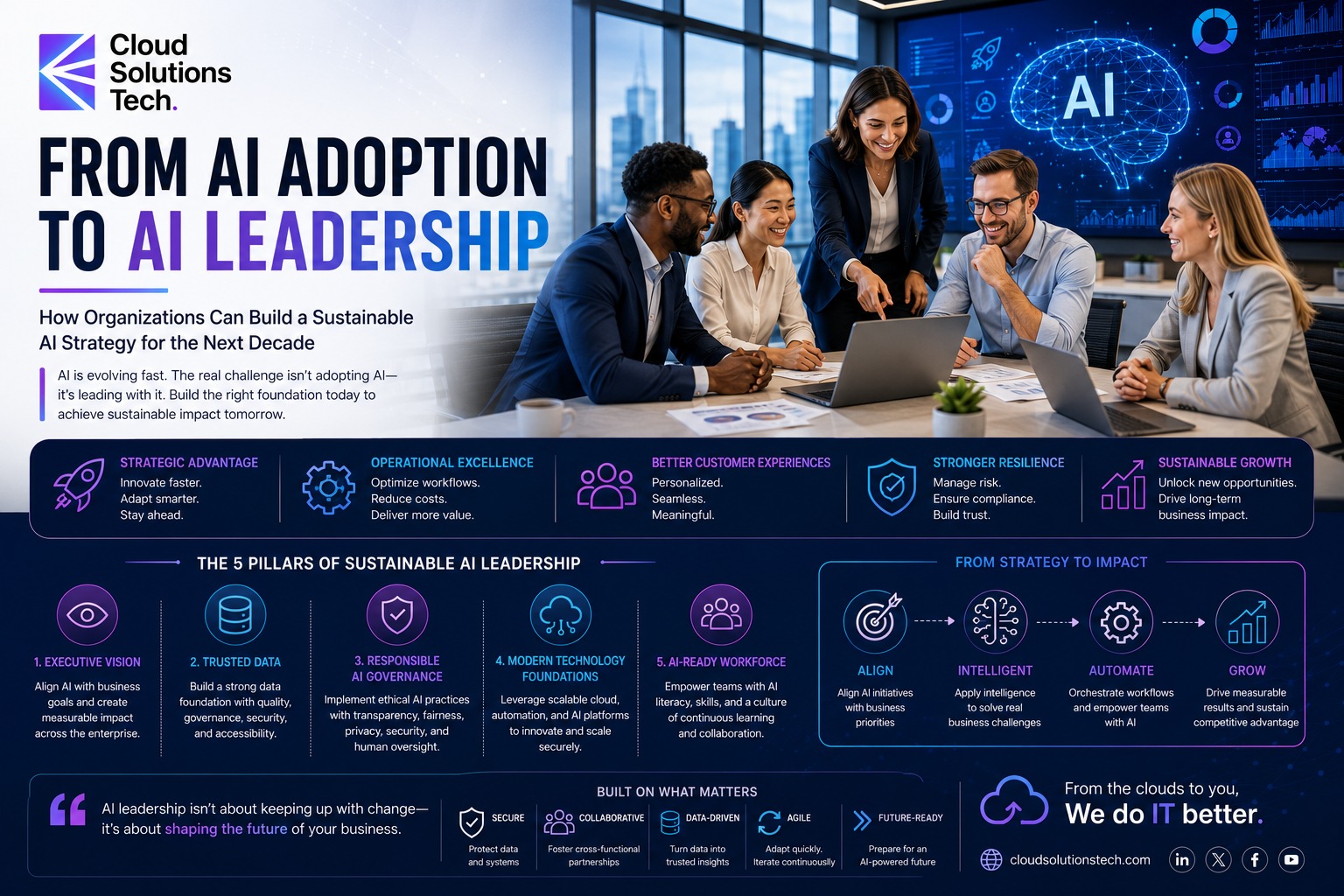
From AI Adoption to AI Leadership
From AI Adoption to AI Leadership
How Organizations Can Build a Sustainable AI Strategy for the Next Decade
Cloud Solutions Tech Executive Insights Series
Artificial Intelligence has rapidly moved from experimentation to enterprise adoption.
Across industries, organizations are deploying AI to improve customer experiences, automate workflows, strengthen cybersecurity, and accelerate innovation.
Yet as AI adoption accelerates, a new question is emerging in boardrooms around the world:
How do we move beyond using AI, and become leaders in AI?
The next decade will not be defined by which organizations adopt AI first.
It will be defined by which organizations build a sustainable AI strategy that delivers long-term business value, responsible innovation, and competitive advantage.
AI leadership is no longer about technology alone.
It is about vision, governance, culture, and execution.
AI Adoption vs. AI Leadership
Many organizations have already adopted AI.
They use chatbots, predictive analytics, AI-powered search, code assistants, and intelligent automation.
These initiatives often deliver measurable improvements.
However, AI leadership goes much further.
AI-leading organizations embed intelligence into every aspect of the business, making AI a strategic capability rather than a standalone project.
Instead of asking:
“Where can we use AI?”
They ask:
“How can AI reshape the way our business creates value?”
That shift in thinking separates AI adopters from AI leaders.
The Five Pillars of Sustainable AI Leadership
Organizations that consistently succeed with AI tend to build their strategy around five interconnected pillars.
1. Executive Vision
AI initiatives must align with business objectives.
Successful leaders establish a clear vision that connects AI investments to measurable outcomes such as:
- Revenue growth
- Customer satisfaction
- Operational efficiency
- Risk reduction
- Innovation
When AI supports business strategy, it becomes a catalyst for transformation rather than another technology initiative.
2. Trusted Data
Artificial Intelligence depends on reliable data.
Without strong data governance, even the most advanced AI models will produce inconsistent or inaccurate results.
Organizations should prioritize:
- Data quality
- Data governance
- Secure storage
- Privacy protection
- Enterprise-wide accessibility
Trusted data creates trusted AI.
3. Responsible AI Governance
As AI becomes more influential in decision-making, governance becomes essential.
Organizations should establish policies that address:
- Transparency
- Fairness
- Privacy
- Security
- Regulatory compliance
- Human oversight
Responsible AI builds confidence among employees, customers, and regulators while reducing long-term risk.
4. Modern Technology Foundations
AI leadership requires modern infrastructure capable of supporting enterprise-scale innovation.
Key components include:
- Cloud-native platforms
- Secure data architectures
- AI development environments
- Automation platforms
- API-first integration
- Observability and monitoring
These technologies provide the flexibility needed to scale AI across the enterprise.
5. AI-Ready Workforce
Technology alone does not create transformation.
People do.
Organizations should invest in developing AI literacy across every level of the business.
Employees need to understand:
- How AI works
- When to trust AI recommendations
- How to collaborate with AI systems
- Ethical AI practices
- Continuous learning
The future workforce will be defined by human expertise enhanced by intelligent systems.
From AI Projects to AI Platforms
One of the biggest mistakes organizations make is treating AI as a collection of isolated initiatives.
Individual pilots may demonstrate value, but they rarely transform the business.
AI leaders instead build enterprise AI platforms that enable:
- Shared models
- Centralized governance
- Reusable capabilities
- Secure integrations
- Consistent user experiences
This platform approach accelerates innovation while reducing operational complexity.
Measuring AI Success
Successful AI strategies focus on measurable business outcomes rather than technical achievements.
Key indicators include:
- Faster decision-making
- Increased employee productivity
- Improved customer experiences
- Lower operational costs
- Reduced security risk
- Greater business agility
AI should ultimately create value that is visible across the organization.
Common Challenges
Building a sustainable AI strategy requires addressing several common challenges.
- Skills Gap: Organizations need professionals who understand both AI technologies and business strategy.
- Data Silos: Disconnected information limits AI effectiveness.
- Governance Complexity: Responsible AI requires clear policies and executive oversight.
- Change Management: Employees must understand how AI enhances, not replaces their work.
- Security: AI systems must be protected against misuse, unauthorized access, and evolving cyber threats.
- Organizations that proactively address these challenges will be better positioned for long-term success.
The Competitive Advantage
AI leadership is becoming a defining characteristic of high-performing enterprises.
Organizations that successfully integrate AI into their culture, operations, and decision-making can:
- Respond faster to market changes
- Innovate continuously
- Deliver more personalized customer experiences
- Improve operational resilience
- Create new business opportunities
In an increasingly competitive digital economy, sustainable AI leadership becomes a strategic differentiator.
Looking Toward the Next Decade
Artificial Intelligence will continue to evolve at an unprecedented pace.
Over the next ten years, organizations will increasingly adopt:
- AI agents
- Autonomous workflows
- Predictive operations
- Intelligent decision support
- Human-AI collaboration
- Industry-specific AI platforms
The enterprises that begin building strong AI foundations today will be best prepared for the opportunities of tomorrow.
Final Takeaway
The future belongs not to organizations that simply adopt Artificial Intelligence, but to those that lead with it.
AI leadership requires more than advanced technology.
It demands executive vision, trusted data, responsible governance, modern cloud infrastructure, and a workforce prepared to thrive alongside intelligent systems.
Organizations that build these capabilities today will shape the next decade of innovation, resilience, and sustainable growth.
The question is no longer whether AI should be part of your business strategy.
The real question is:
Will your organization follow the AI revolution or lead it?
What’s Next?
Next Week:
AI Governance in the Enterprise — Building Trust, Security, and Responsible Innovation at Scale
From the clouds to you,
We do IT better.