
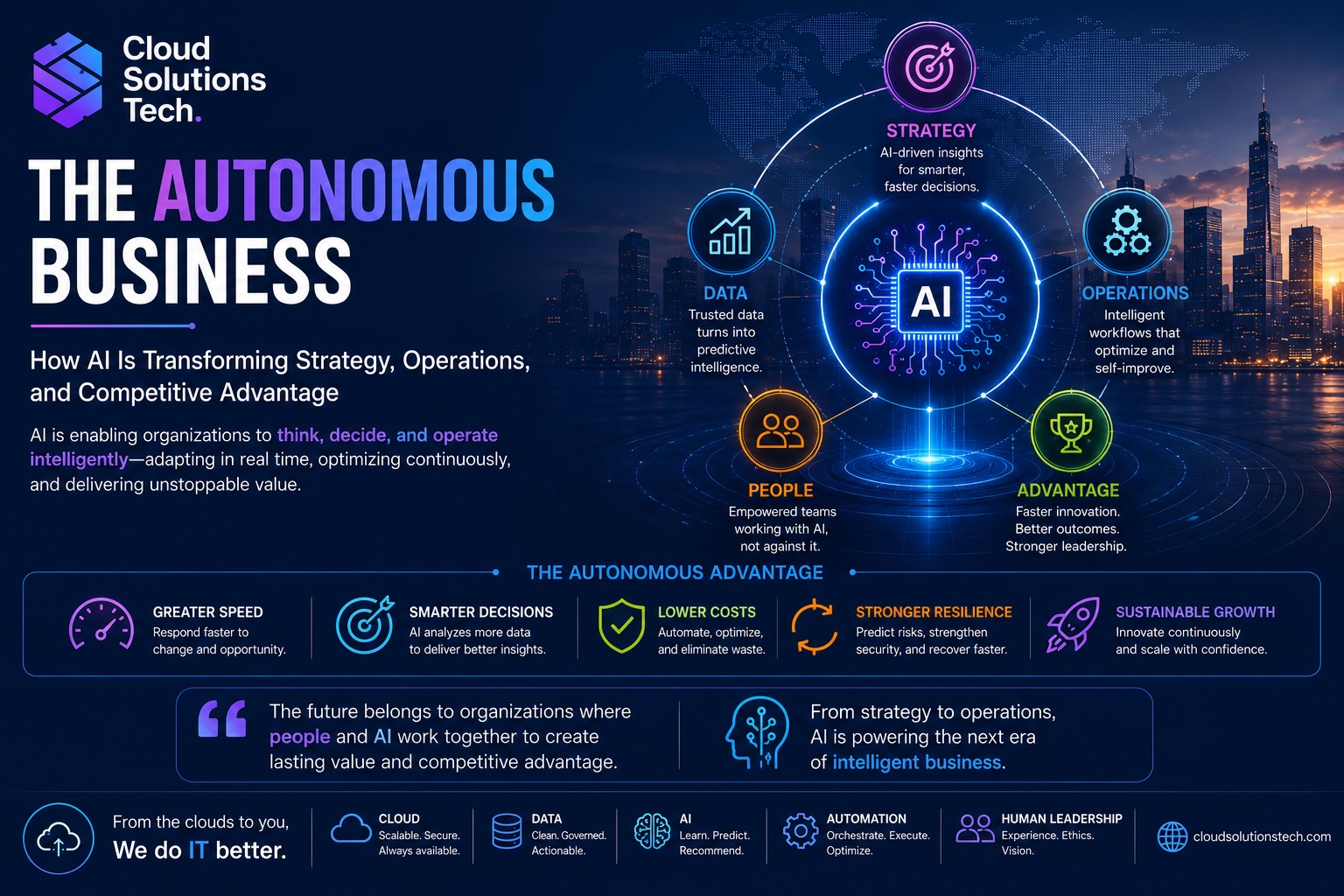
The Autonomous Business
How AI Is Transforming Strategy, Operations, and Competitive Advantage
Cloud Solutions Tech Executive Insights Series
For decades, organizations have measured digital transformation by how effectively they adopted cloud computing, automation, and data analytics.
Today, a new transformation is taking shape.
Businesses are evolving from being digitally enabled to becoming autonomous.
Powered by Artificial Intelligence, modern enterprises are no longer simply automating routine tasks, they are redesigning how strategic decisions are made, how operations are executed, and how competitive advantage is created.
The Autonomous Business represents the next stage of enterprise evolution, where intelligent systems continuously analyze, learn, recommend, and act to help organizations operate faster, smarter, and more efficiently.
This is no longer a vision for the future, it is becoming the reality of business in 2026.
What Is an Autonomous Business?
An Autonomous Business is an organization that integrates AI into its core operating model, allowing intelligent systems to support or execute business processes with minimal human intervention.
Unlike traditional automation, which relies on predefined rules, autonomous systems can:
- Analyze changing business conditions
- Predict future outcomes
- Make informed recommendations
- Coordinate cross-functional workflows
- Continuously optimize performance
Human leadership remains essential, but AI increasingly serves as an intelligent partner in daily operations.
Strategy Is Becoming AI-Driven
Executive decision-making has traditionally relied on historical reports, quarterly reviews, and manual analysis.
Today, AI is enabling leaders to make decisions based on real-time intelligence.
Modern AI platforms can:
- Monitor business performance continuously
- Forecast market trends
- Identify emerging risks
- Simulate business scenarios
- Recommend strategic actions
This allows executives to move from reactive planning to proactive decision-making.
Organizations that leverage AI-driven strategy can respond to market changes with greater speed and confidence.
Intelligent Operations at Scale
Operational excellence has always been a competitive advantage.
AI is now redefining what operational excellence looks like.
Across the enterprise, intelligent systems are improving:
- IT Operations: AI monitors infrastructure, predicts failures, optimizes cloud resources, and supports automated incident response.
- Customer Experience: AI personalizes interactions, accelerates support, and delivers more consistent service across digital channels.
- Finance: Intelligent workflows streamline forecasting, procurement, expense management, and financial reporting.
- Supply Chain: AI improves inventory planning, demand forecasting, logistics optimization, and supplier risk management.
- Cybersecurity: AI continuously analyzes threats, prioritizes incidents, and strengthens organizational resilience through intelligent detection and response.
Rather than optimizing individual departments, AI enables organizations to optimize the enterprise as a whole.
The New Source of Competitive Advantage
Technology alone is no longer the differentiator.
Competitive advantage increasingly depends on how effectively organizations combine:
- Cloud computing
- Trusted data
- Artificial Intelligence
- Automation
- Human expertise
Together, these capabilities enable businesses to:
- Launch products faster
- Deliver superior customer experiences
- Reduce operational costs
- Improve decision quality
- Respond more rapidly to changing market conditions
Organizations that embrace intelligent business models are positioning themselves to outperform competitors that rely solely on traditional operating methods.
Human Intelligence Meets Artificial Intelligence
One of the biggest misconceptions about AI is that it replaces people.
In reality, the most successful organizations use AI to augment human capabilities.
Humans contribute:
- Leadership
- Creativity
- Ethical judgment
- Relationship management
- Strategic thinking
AI contributes:
- Speed
- Scale
- Pattern recognition
- Continuous monitoring
- Data-driven insights
Together, they create an organization that is both more productive and more innovative.
The future of business is collaborative, not competitive between humans and AI.
Governance Remains Essential
As businesses become increasingly autonomous, governance becomes more important than ever.
Executive leaders should prioritize:
- Responsible AI: Ensure AI systems operate ethically and transparently.
- Data Governance: Maintain trusted, secure, and high-quality enterprise data.
- Cybersecurity: Protect AI models, business systems, and sensitive information.
- Regulatory Compliance: Align AI adoption with industry regulations and organizational policies.
- Human Oversight: Critical business decisions should always include appropriate human accountability.
- Responsible governance builds the trust needed to scale AI across the enterprise.
Building the Autonomous Business
Organizations looking to become more autonomous should focus on five strategic priorities:
- Modernize the Cloud Foundation: Adopt scalable, resilient cloud platforms capable of supporting AI workloads.
- Strengthen Data Quality: Reliable AI depends on trusted, well-governed enterprise data.
- Embed AI Across Business Functions: Move beyond isolated AI projects and integrate intelligence throughout the organization.
- Automate End-to-End Workflows: Connect systems, applications, and teams through intelligent orchestration.
- Invest in People: Equip employees with the skills needed to collaborate effectively with AI-powered systems.
Technology alone will not create an autonomous business, people, culture, and leadership remain equally important.
Looking Ahead
Over the next decade, organizations will continue evolving from:
- Digital Businesses
- AI-Assisted Businesses
- AI-Powered Enterprises
- Autonomous Businesses
Future enterprises will increasingly operate with intelligent systems capable of anticipating business needs, coordinating operations, and supporting strategic growth in real time.
The organizations that begin building these capabilities today will be the market leaders of tomorrow.
Final Takeaway
The Autonomous Business is not about replacing human decision-making.
It is about enhancing it.
By combining cloud, trusted data, artificial intelligence, and intelligent automation, organizations can create business models that are faster, more adaptive, and more resilient than ever before.
Competitive advantage in 2026 will not be defined by who has the most technology.
It will be defined by who uses technology most intelligently.
The future belongs to organizations where people and AI work together to transform strategy into action, operations into innovation, and data into lasting business value.
What’s Next?
Next Week:
From AI Adoption to AI Leadership — How Organizations Can Build a Sustainable AI Strategy for the Next Decade
From the clouds to you,
We do IT better.