
Beyond Automation
How AI-Orchestrated Workflows Are Reshaping Enterprise Productivity
Cloud Solutions Tech Executive Insights Series
For years, organizations have pursued automation to improve efficiency, reduce costs, and eliminate repetitive work. From Robotic Process Automation (RPA) to scripted workflows and business process automation, these technologies have transformed how enterprises operate.
But in 2026, automation alone is no longer enough.
Organizations are entering a new era where Artificial Intelligence doesn’t simply execute predefined tasks, it coordinates, adapts, and optimizes entire business processes in real time.
This evolution is known as AI-Orchestrated Workflows, and it is fundamentally changing enterprise productivity.
Rather than automating individual tasks, businesses are now orchestrating intelligent workflows that can learn, make decisions, and continuously improve.
From Task Automation to Intelligent Orchestration
Traditional automation follows fixed instructions.
If a specific event occurs, the system performs a predefined action.
While effective for repetitive processes, these workflows struggle when business conditions change or when decisions require context.
AI orchestration introduces a new level of intelligence.
Instead of simply following rules, AI can:
- Understand business objectives
- Analyze real-time data
- Prioritize actions
- Coordinate multiple systems
- Adapt to changing conditions
- Recommend or execute the next best action
The result is a workflow that becomes increasingly intelligent over time.
What Is an AI-Orchestrated Workflow?
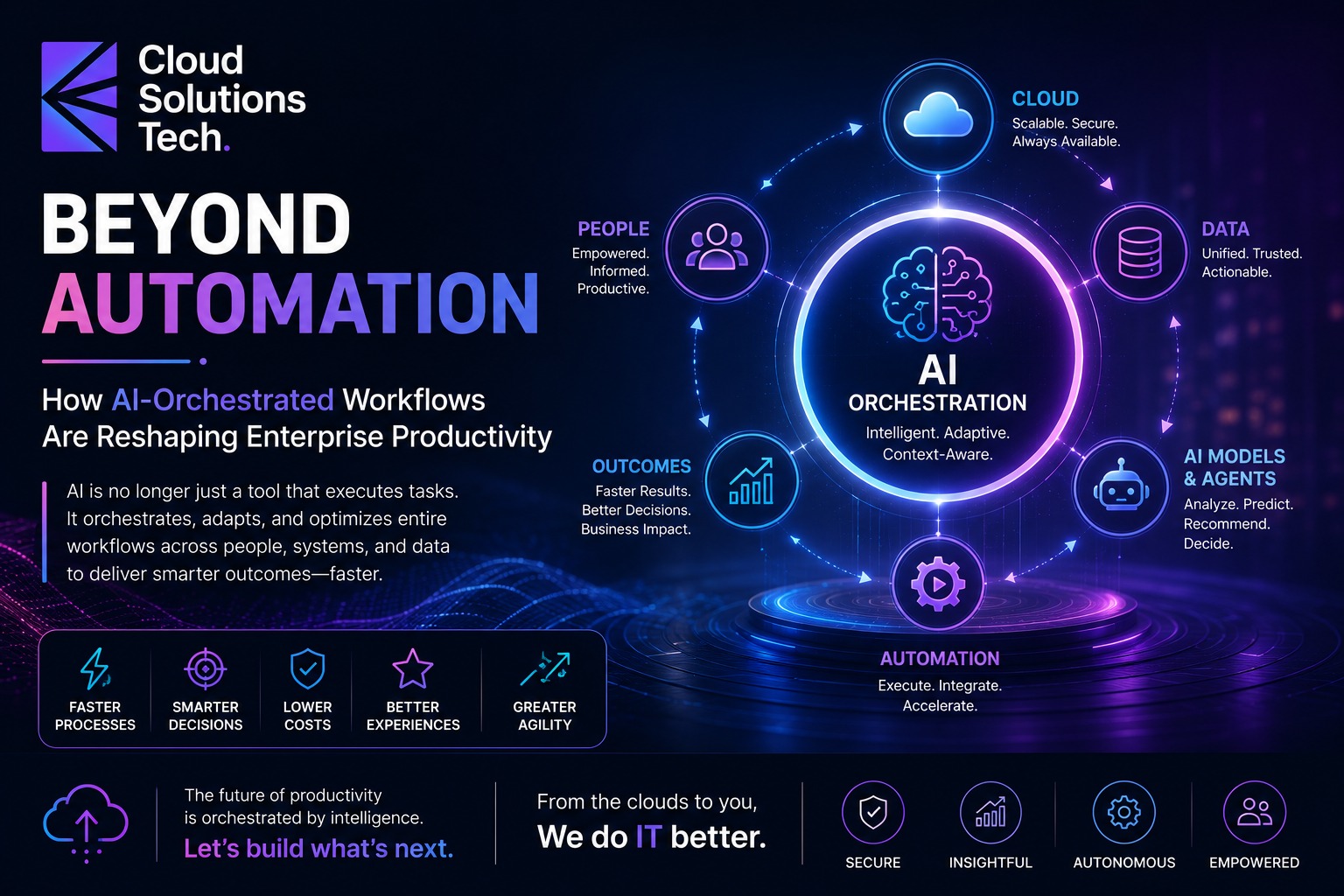
- An AI-orchestrated workflow combines cloud services, enterprise applications, data platforms, AI models, and automation tools into a unified business process.
- Rather than operating independently, these systems communicate and collaborate to complete complex tasks with minimal human intervention.
- Think of AI as the conductor of an orchestra.
- Each application, database, and automation platform plays its own role, but AI ensures they work together in harmony to achieve the desired business outcome.
Where Organizations Are Seeing the Biggest Impact
Customer Experience
AI now orchestrates customer journeys across multiple channels.
From initial inquiries to support, billing, and follow-up communications, intelligent workflows deliver faster, more personalized experiences while reducing manual effort.
IT Operations
Modern IT teams are using AI to coordinate infrastructure monitoring, incident management, resource optimization, and automated remediation.
Instead of reacting to issues after they occur, AI helps identify risks early and initiates corrective actions automatically.
Cybersecurity
Security operations increasingly rely on AI-orchestrated workflows to correlate alerts, investigate suspicious activity, prioritize incidents, and accelerate response times.
This allows security teams to focus on strategic threats rather than routine investigations.
Finance and Operations
Organizations are streamlining financial processes such as invoice approvals, expense management, procurement, and forecasting through intelligent workflows that reduce processing time while improving accuracy and compliance.
The Technology Behind Intelligent Workflows
- Successful AI orchestration depends on several interconnected technologies.
- Cloud Platforms: Provide the scalable infrastructure needed to run enterprise applications and AI workloads.
- Enterprise Data: Delivers trusted information that enables AI to make informed decisions.
- AI Models and Agents: Analyze context, predict outcomes, and recommend actions.
- Automation Platforms: Execute tasks across business applications, APIs, and enterprise systems.
- Observability and Governance: Ensure workflows remain secure, transparent, and compliant throughout their lifecycle.
- Together, these components create a modern operational framework that continuously adapts to business needs.
Why Executive Leaders Should Care
AI-orchestrated workflows are not simply about reducing manual work.
They represent a new approach to enterprise execution.
Organizations adopting this model are experiencing:
- Faster business processes
- Improved employee productivity
- Better customer experiences
- More consistent compliance
- Lower operational costs
- Greater organizational agility
Perhaps most importantly, intelligent workflows allow employees to spend less time managing processes and more time driving innovation.
Governance Must Keep Pace
As workflows become increasingly autonomous, governance becomes essential.
Organizations should establish clear policies around:
- AI decision transparency
- Human oversight
- Data privacy
- Security controls
- Regulatory compliance
- Continuous monitoring
Responsible AI orchestration ensures organizations gain the benefits of automation without sacrificing trust or accountability.
Looking Ahead
- The next phase of enterprise transformation will not be defined by isolated automation projects.
- It will be driven by intelligent ecosystems where AI continuously coordinates people, applications, and business processes.
- Workflows will become increasingly adaptive, predictive, and self-optimizing.
- Organizations that embrace this shift today will be better positioned to compete in tomorrow’s digital economy.
Final Takeaway
- Automation helped organizations eliminate repetitive tasks.
- AI orchestration is helping organizations rethink how work gets done altogether.
- By combining cloud, data, artificial intelligence, and automation into intelligent workflows, enterprises can operate with greater speed, resilience, and precision.
- The future of productivity is no longer about automating individual tasks.
- It is about orchestrating intelligent business outcomes.
- The organizations that master AI-orchestrated workflows will define the next generation of operational excellence.
What’s Next?
Next Week:
The Autonomous Business — How AI Is Transforming Strategy, Operations, and Competitive Advantage
From the clouds to you,