
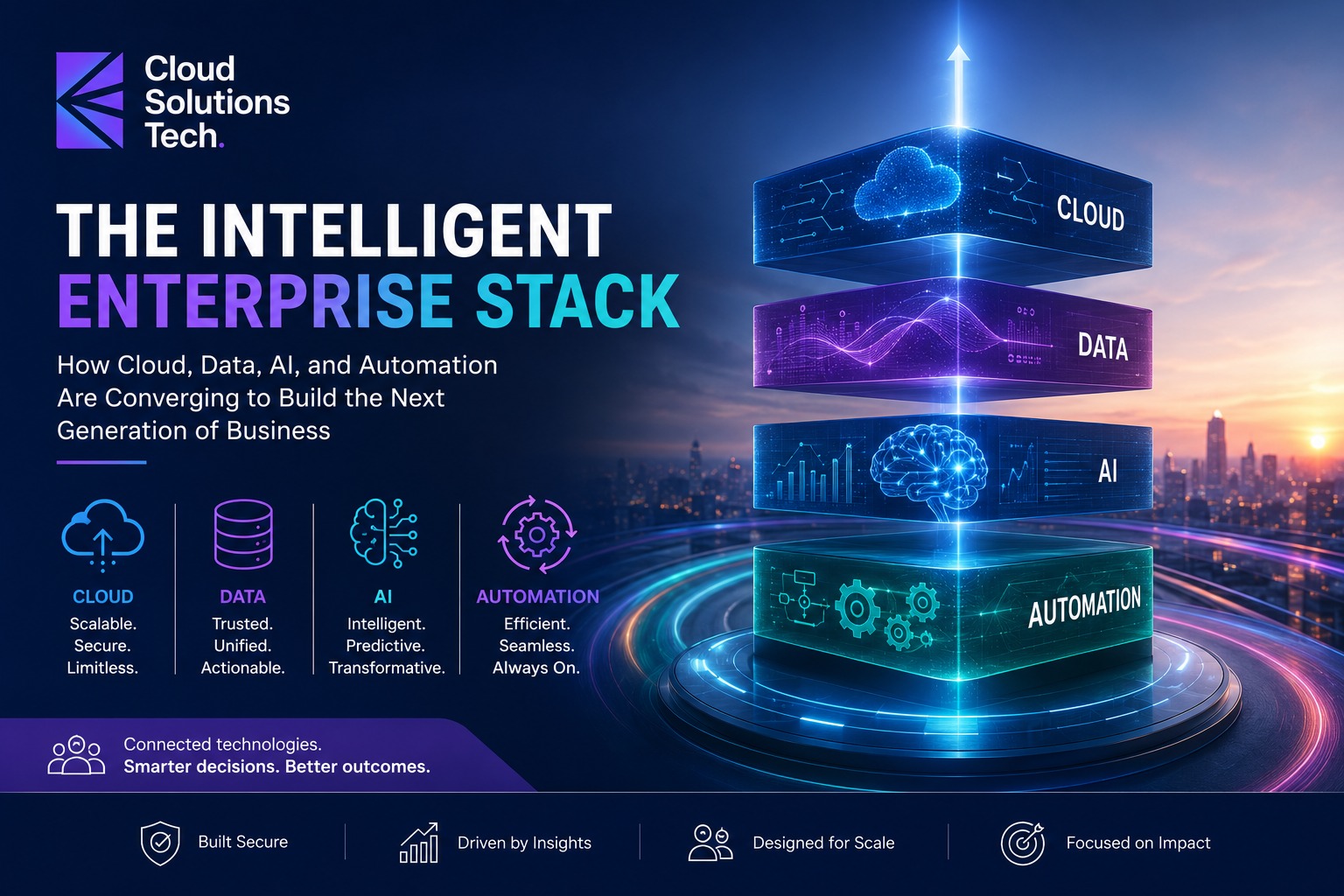
The Intelligent Enterprise Stack
The Intelligent Enterprise Stack
How Cloud, Data, AI, and Automation Are Converging to Build the Next Generation of Business
Cloud Solutions Tech Executive Insights Series
Digital transformation is no longer about adopting individual technologies. The organizations leading in 2026 are succeeding because they have integrated cloud, data, artificial intelligence, and automation into a single, intelligent operating model.
This convergence is giving rise to what many industry leaders now describe as The Intelligent Enterprise Stack.
Rather than viewing cloud, AI, analytics, and automation as separate initiatives, forward-thinking organizations are treating them as interconnected capabilities that work together to drive innovation, agility, and business value.
The future belongs to enterprises that build technology ecosystems, not technology silos.
What Is the Intelligent Enterprise Stack?
The Intelligent Enterprise Stack is the modern digital foundation that combines four essential technology pillars:
- Cloud Infrastructure
- Enterprise Data
- Artificial Intelligence
- Automation
Each layer strengthens the others.
Cloud provides scalability.
Data provides intelligence.
AI provides decision-making.
Automation provides execution.
Together, they enable organizations to operate faster, smarter, and more efficiently than ever before.
The Four Pillars of the Intelligent Enterprise
1. Cloud: The Digital Foundation
Every modern enterprise begins with the cloud.
Cloud platforms provide the secure, scalable infrastructure needed to support today’s digital workloads from business applications and data platforms to AI models and global collaboration.
Cloud enables organizations to:
- Scale on demand
- Improve resilience
- Reduce infrastructure complexity
- Accelerate innovation
- Support hybrid and remote work
Without the cloud, the intelligent enterprise cannot operate at scale.
2. Data: The Strategic Asset
Data is often described as the new fuel of the digital economy, but raw data alone has limited value.
Organizations must transform data into trusted, governed, and actionable information.
This requires:
- Strong data governance
- High-quality data pipelines
- Secure storage
- Real-time analytics
- Unified enterprise visibility
When managed effectively, data becomes the foundation for better business decisions and AI-driven innovation.
3. Artificial Intelligence: The Intelligence Layer
Artificial Intelligence transforms information into insight.
Modern AI platforms can:
- Analyze massive datasets
- Detect trends and anomalies
- Generate recommendations
- Predict future outcomes
- Assist with strategic decision-making
Increasingly, AI is becoming the intelligence engine embedded across every business function from customer service and cybersecurity to finance, software engineering, and executive planning.
4. Automation: The Execution Engine
Insight alone does not create value.
Organizations must be able to act quickly.
Automation converts intelligence into action by orchestrating workflows, reducing manual effort, and accelerating business processes.
Examples include:
- Automated infrastructure provisioning
- CI/CD pipelines
- Security response workflows
- Business process automation
- Compliance reporting
- Intelligent document processing
Automation allows organizations to execute consistently, accurately, and at enterprise scale.
Why Convergence Matters
Historically, these technologies were implemented independently.
- Cloud teams focused on infrastructure.
- Data teams managed analytics.
- AI teams built models.
- Operations teams automated workflows.
Today, those boundaries are disappearing.
The Intelligent Enterprise Stack brings these capabilities together into a unified ecosystem where each technology enhances the others.
This convergence enables organizations to move from isolated improvements to enterprise-wide transformation.
Business Outcomes That Matter
Organizations adopting an Intelligent Enterprise Stack are realizing measurable benefits, including:
- Faster decision-making through real-time insights
- Greater operational efficiency with intelligent automation
- Stronger cybersecurity powered by AI-driven detection
- Accelerated software delivery through cloud-native DevSecOps
- Improved customer experiences with personalized digital services
- Enhanced governance, compliance, and risk management
Technology investments become directly aligned with business outcomes.
Leadership Priorities for 2026
As organizations modernize their technology strategies, executive leaders should focus on:
- Build on a Cloud-First Foundation – Adopt scalable, secure cloud architectures that support future growth.
- Treat Data as a Strategic Asset – Invest in governance, quality, and accessibility to maximize the value of enterprise data.
- Embed AI Responsibly – Integrate AI into business processes while maintaining transparency, security, and human oversight.
- Automate with Purpose – Prioritize automation that improves efficiency, reduces risk, and enables employees to focus on higher-value work.
- Strengthen Security and Governance – Ensure every layer of the stack is protected through zero trust principles, identity management, continuous monitoring, and regulatory compliance.
Looking Ahead
The next generation of successful enterprises will not be defined by how much technology they own, but by how well their technologies work together.
Cloud, data, AI, and automation are no longer separate investments, they are interconnected capabilities that form the foundation of modern business.
Organizations that embrace this integrated approach will be better positioned to innovate, adapt, and compete in an increasingly digital world.
Final Takeaway
The Intelligent Enterprise Stack is more than a technology architecture, it is a business strategy.
It enables organizations to transform data into intelligence, intelligence into action, and action into measurable business value.
As digital transformation continues to evolve, success will depend on building connected, intelligent, and secure technology ecosystems rather than isolated solutions.
The enterprises that master this convergence today will define the next generation of business leadership tomorrow.
What’s Next?
Next Week:
Beyond Automation — How AI-Orchestrated Workflows Are Reshaping Enterprise Productivity
From the clouds to you,