
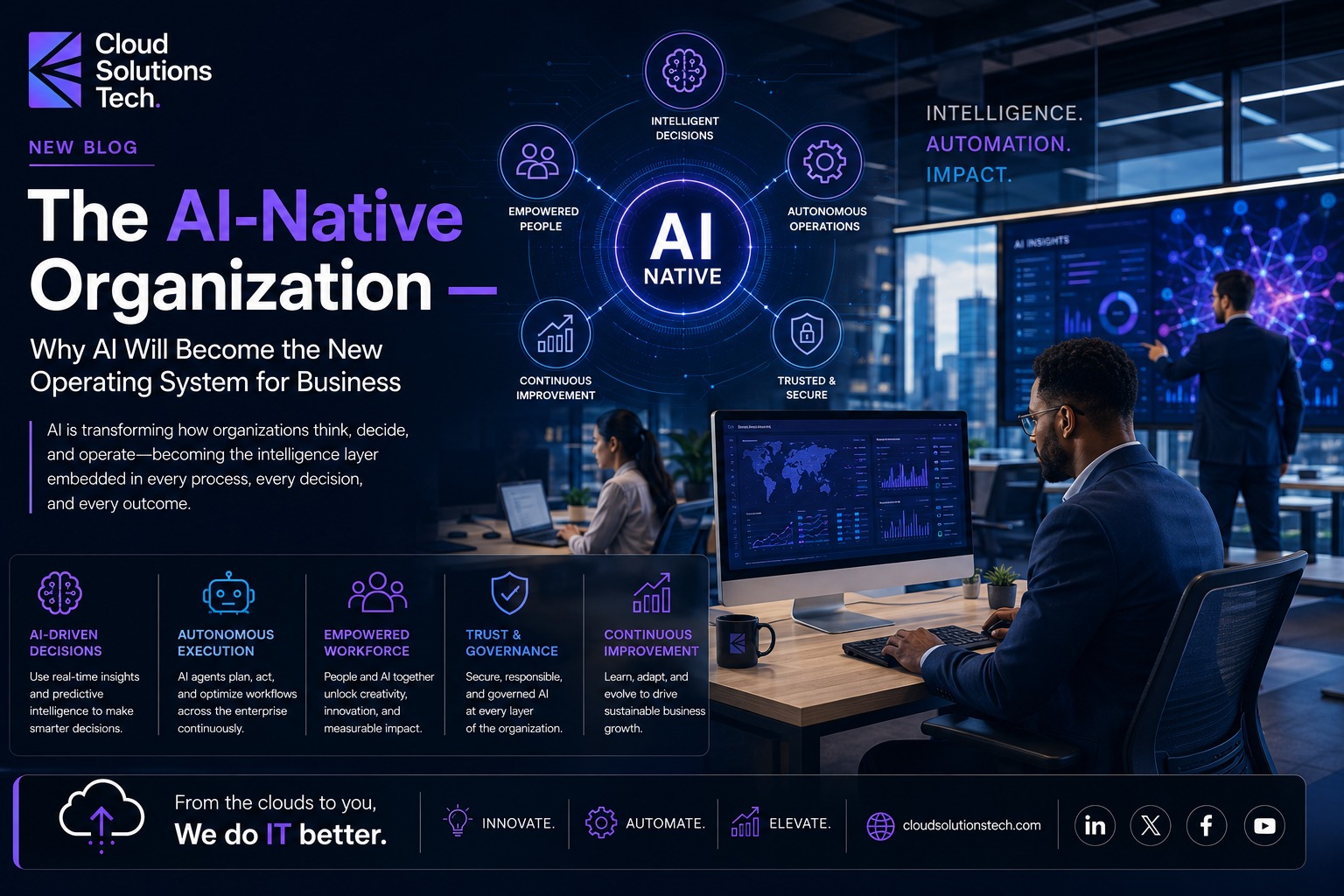
The AI-Native Organization
Why AI Will Become the New Operating System for Business
Cloud Solutions Tech Executive Insights Series
Artificial Intelligence is no longer simply enhancing business processes.
It is beginning to redefine how organizations are built, managed, and operated.
Over the past several years, enterprises have progressed through distinct stages of AI adoption:
- AI as a productivity tool
- AI as a business assistant
- AI as an intelligent agent
- AI as an autonomous executor
The next evolution is even more profound.
Organizations are becoming AI-Native.
In an AI-native organization, Artificial Intelligence is not an add-on to existing systems, it becomes the foundation upon which business operations are designed.
Much like operating systems transformed personal computing, AI is poised to become the operating system of the modern enterprise.
What Is an AI-Native Organization?
An AI-native organization is one where Artificial Intelligence is embedded into every layer of the business.
Rather than treating AI as a separate technology initiative, it becomes part of how the organization:
- Makes decisions
- Serves customers
- Develops products
- Operates infrastructure
- Protects data
- Optimizes workflows
- Enables employees
AI becomes a strategic capability woven into the organization’s DNA.
The Evolution of Enterprise Technology
Enterprise technology has evolved through several transformational eras.
The Mainframe Era: Organizations centralized computing resources to improve operational efficiency.
The Internet Era: Businesses became globally connected and digitally enabled.
The Cloud Era: Infrastructure became scalable, agile, and accessible from anywhere.
The AI Era: Organizations gained the ability to automate analysis and support decision-making.
The AI-Native Era: Artificial Intelligence becomes the intelligence layer powering every business function.
This marks one of the most significant shifts in enterprise computing since the adoption of cloud technologies.
Why AI Is Becoming the Operating System for Business
Every organization generates enormous amounts of information.
Customer interactions.
Operational metrics.
Financial data.
Cybersecurity events.
Supply chain activities.
Employee collaboration.
Historically, humans were responsible for interpreting this information and deciding what actions to take.
AI changes this model.
Instead of waiting for people to analyze data manually, intelligent systems can:
- Continuously monitor events
- Detect patterns
- Recommend actions
- Execute workflows
- Learn from outcomes
Business execution becomes faster, more intelligent, and increasingly autonomous.
Characteristics of an AI-Native Organization
Organizations leading this transformation typically share several characteristics.
AI-Driven Decision Making
Leaders use AI-generated insights to support strategic, operational, and financial decisions.
Rather than relying solely on historical reports, organizations gain real-time intelligence that improves responsiveness and accuracy.
Digital Workers Alongside Human Employees
AI agents become part of everyday operations.
They assist with:
- Customer support
- Knowledge retrieval
- Software development
- Cybersecurity monitoring
- IT operations
- Financial analysis
- Compliance management
Human employees focus on leadership, creativity, innovation, and complex problem-solving.
Continuous Intelligence
Instead of periodic reporting, organizations receive continuous operational intelligence.
AI constantly evaluates business performance, identifies risks, and uncovers opportunities for improvement.
Automation by Default
Routine work increasingly becomes automated.
Employees no longer spend valuable time on repetitive administrative tasks.
Instead, AI handles execution while people focus on strategic initiatives.
Learning Organizations
AI-native enterprises continuously improve.
Every interaction generates data that helps refine models, optimize workflows, and enhance future performance.
Learning becomes an organizational capability rather than an occasional project.
Business Functions Being Transformed
Executive Leadership
AI provides executives with:
- Predictive forecasting
- Strategic recommendations
- Risk assessments
- Market intelligence
- Real-time dashboards
Leadership decisions become more data-driven and proactive.
Customer Experience
AI enables organizations to deliver:
- Personalized interactions
- Intelligent recommendations
- Faster service
- Predictive customer support
Customer engagement becomes more responsive and relevant.
IT Operations
AI-native IT environments leverage intelligent systems for:
- Infrastructure monitoring
- Capacity optimization
- Automated remediation
- Root cause analysis
Operations become increasingly resilient and self-healing.
Cybersecurity
Security operations evolve through:
- AI-powered threat detection
- Behavioral analytics
- Automated incident response
- Risk prioritization
- Continuous monitoring
Cyber defense becomes more adaptive and proactive.
Software Engineering
Development teams benefit from AI-assisted:
- Code generation
- Code review
- Testing
- Documentation
- Deployment optimization
This accelerates software delivery while improving quality.
Business Operations
Across finance, HR, procurement, legal, and supply chain functions, AI automates routine tasks while enhancing strategic decision-making.
Operational efficiency improves without sacrificing governance.
The Technology Foundation
Building an AI-native organization requires more than deploying AI models.
Organizations need a modern technology foundation built on:
- Cloud Infrastructure: Scalable computing, storage, and networking.
- Enterprise Data Platforms: Trusted, secure, and well-governed data.
- AI Platforms: Model development, deployment, orchestration, and monitoring.
- Automation Frameworks: Workflow automation integrated across business systems.
- Security and Governance: Robust controls for identity, compliance, privacy, and responsible AI.
- These components work together to support enterprise-scale AI adoption.
Challenges Organizations Must Address
Transitioning to an AI-native model is not without challenges.
Organizations must navigate:
- Data Quality: Poor-quality data limits AI effectiveness.
- Security: AI systems must be protected against misuse and unauthorized access.
- Governance: Clear policies are essential to ensure responsible AI deployment.
- Change Management: Employees need support, training, and confidence to work alongside AI.
- Ethics: Organizations must ensure fairness, transparency, and accountability in AI-driven decisions.
- Addressing these challenges is essential for long-term success.
The Leadership Imperative
Becoming AI-native is not simply a technology initiative.
It is a business transformation.
Executive leaders should focus on:
- Aligning AI investments with business strategy
- Building AI-ready cultures
- Strengthening governance
- Modernizing cloud infrastructure
- Developing AI literacy across the workforce
Organizations that invest early will be better positioned to compete in the coming decade.
The Future of Competitive Advantage
In the years ahead, competitive advantage will increasingly depend on how effectively organizations integrate AI into their operations.
Success will not be determined solely by:
- Cloud adoption
- Automation
- Digital transformation
It will be determined by how intelligently organizations can operate.
AI-native enterprises will be able to:
- Adapt faster
- Innovate continuously
- Make smarter decisions
- Deliver better customer experiences
- Operate with greater resilience
The organizations that embrace this model today will define tomorrow’s industry leaders.
Final Takeaway
Artificial Intelligence is evolving from a business tool into the intelligence layer that powers the modern enterprise.
The AI-native organization represents the next chapter of digital transformation, one where humans and AI work together to create more agile, intelligent, and resilient businesses.
As cloud transformed infrastructure and the internet transformed communication, AI is now transforming how organizations think, decide, and execute.
The question is no longer whether businesses will adopt AI.
The question is whether they will become AI-native before their competitors do.
Because the future belongs to organizations where intelligence is built into every process, every decision, and every outcome.
What’s Next?
Next Week:
The Intelligent Enterprise Stack — How Cloud, Data, AI, and Automation Are Converging to Build the Next Generation of Business
From the clouds to you,
We do IT better.