
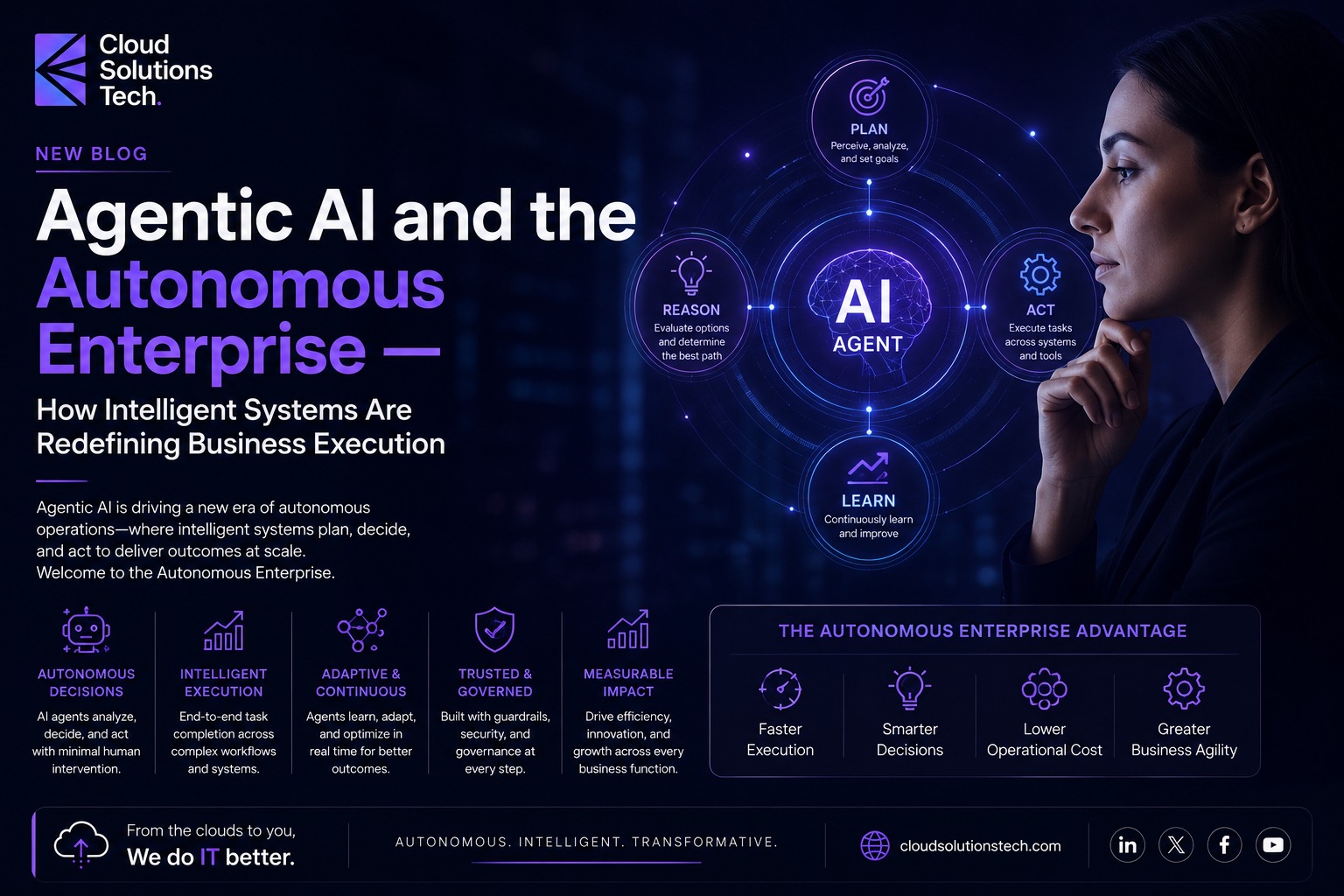
Agentic AI and the Autonomous Enterprise.
How Intelligent Systems Are Redefining Business Execution
Cloud Solutions Tech Executive Insights Series
Artificial Intelligence has already transformed how organizations analyze information, automate tasks, and improve decision-making.
But a much bigger shift is now underway.
We’re moving beyond AI assistants and chatbots into an entirely new era: Agentic AI.
In 2026, organizations are beginning to embrace intelligent systems capable of planning, reasoning, acting, and continuously learning with minimal human intervention.
This marks the rise of the Autonomous Enterprise, an organization where humans and AI agents collaborate to execute business operations faster, smarter, and more efficiently than ever before.
The future of work is no longer simply AI-assisted.
It is increasingly AI-driven.
What Is Agentic AI?
Traditional AI systems primarily respond to prompts.
Agentic AI goes much further.
Agentic AI refers to intelligent systems capable of:
- Understanding goals
- Planning tasks
- Making decisions
- Executing actions
- Learning from outcomes
- Adapting continuously
Unlike conventional automation, Agentic AI can autonomously coordinate complex workflows across systems, applications, and business functions.
The result is a shift from simple task automation to intelligent business execution.
The Rise of the Autonomous Enterprise
For decades, organizations have relied on people to coordinate operations manually.
Employees manage:
- Emails
- Workflows
- Tickets
- Reports
- Requests
- Approvals
- Research
- Analysis
Agentic AI changes this operating model.
The Autonomous Enterprise combines:-
- Human Expertise: Strategic thinking, creativity, and judgment.
- AI Agents: Continuous execution, analysis, coordination, and optimization.
- Together, they create a new digital operating model capable of scaling far beyond traditional business processes.
Why Agentic AI Matters in 2026
Business complexity is increasing rapidly.
Organizations face:
- Workforce shortages
- Rising operational costs
- Massive data growth
- Faster market demands
- Cybersecurity threats
- Increasing compliance requirements
Traditional automation cannot solve these challenges alone.
Agentic AI enables organizations to move from reactive operations to intelligent execution.
This creates:
- Faster decisions
- Greater agility
- Increased productivity
- Improved customer experiences
- Lower operational costs
How Agentic AI Works
Most AI agents operate through four fundamental stages:-
- Perceive: Understand objectives, context, and available information.
- Reason: Evaluate options and determine the best path forward.
- Act: Execute tasks across systems and workflows.
- Learn: Analyze outcomes and continuously improve future performance.
- This feedback loop allows intelligent agents to become increasingly effective over time.
Enterprise Use Cases for Agentic AI
Customer Experience
AI agents can:
- Resolve support tickets
- Personalize interactions
- Manage customer requests
- Escalate complex issues
Organizations gain faster response times and improved customer satisfaction.
IT Operations
Agentic AI enables:
- Root cause analysis
- Automated remediation
- Infrastructure optimization
- Capacity forecasting
Operations become increasingly proactive rather than reactive.
Cybersecurity
Security teams are deploying AI agents to:
- Investigate alerts
- Correlate events
- Analyze threats
- Recommend actions
- Accelerate incident response
AI agents act as force multipliers for security operations.
Finance and Procurement
Autonomous systems can:
- Process invoices
- Analyze contracts
- Manage vendors
- Detect anomalies
- Forecast spending
Reducing manual work improves both speed and accuracy.
Human Resources
AI agents can streamline:
- Candidate screening
- Employee onboarding
- Policy support
- Workforce analytics
This enables HR teams to focus more on people and culture.
Knowledge Management
Agentic AI allows organizations to:
- Search enterprise knowledge
- Summarize documents
- Generate reports
- Assist employees with research
Information becomes instantly accessible.
Multi-Agent Systems: Digital Teams at Work
Perhaps the most exciting development in 2026 is the emergence of multi-agent architectures.
Rather than deploying a single AI agent, organizations are building entire ecosystems of specialized agents.
Examples include:
- Research Agent: Finds and analyzes information.
- Security Agent: Monitors threats and vulnerabilities.
- Compliance Agent: Tracks policies and regulatory requirements.
- Finance Agent: Manages budgeting and forecasting.
- Operations Agent: Coordinates workflows and resources.
- These digital workers collaborate with each other just as human teams do.
Human + AI: The Winning Formula
Agentic AI is not replacing people.
It is augmenting them.
Humans provide:
- Leadership
- Ethics
- Creativity
- Strategic thinking
- Relationship building
AI agents provide:
- Speed
- Scale
- Automation
- Pattern recognition
- Continuous execution
The future workforce is a partnership between humans and intelligent systems.
Organizations that embrace this collaboration will outperform those that resist it.
Governance Becomes Essential
As AI systems gain autonomy, governance becomes increasingly important.
Executive leaders must address:-
- Security: How are agents authenticated and controlled?
- Data Privacy: What information can agents access?
- Explainability: Can decisions be understood and audited?
- Compliance: Are regulatory requirements being enforced?
- Accountability: Who remains responsible for AI actions?
- Trust remains the foundation of successful AI adoption.
What Leaders Should Focus On
Organizations preparing for Agentic AI should prioritize:_
- AI Governance Frameworks: Ensuring responsible and secure AI deployment.
- Trusted Data Foundations: AI is only as good as the data behind it.
- Cloud and AI Infrastructure: Scalable platforms are essential.
- Workforce Readiness: Employees must learn to collaborate effectively with AI agents.
- Human Oversight: Critical decisions should always retain appropriate human involvement.
The Competitive Advantage
Organizations that successfully adopt Agentic AI will benefit from:
- Faster execution
- Reduced operational costs
- Better decision-making
- Improved customer experiences
- Increased innovation
- Greater business agility
Agentic AI is quickly becoming a strategic differentiator.
The Future of Business Execution
Over the next several years, organizations will evolve from:
- AI-Assisted Organizations
- ↓
- AI-Powered Organizations
- ↓
- Autonomous Enterprises
Business processes will increasingly become:
- Intelligent
- Adaptive
- Predictive
- Self-optimizing
Human teams will work alongside digital workers to deliver outcomes at unprecedented speed and scale.
Final Takeaway
Agentic AI represents the next major evolution in enterprise technology.
Organizations are moving beyond isolated AI tools and toward intelligent systems capable of executing complex business processes autonomously.
The Autonomous Enterprise is no longer science fiction.
It is emerging today.
Those who build trusted, governed, and scalable AI ecosystems will define the next era of business execution.
Because in 2026, the question is no longer: Can AI help my business?
The question has become: How autonomous should my enterprise become?
What’s Next?
Next Week:
The AI-Native Organization — Why AI Will Become the New Operating System for Business
From the clouds to you,
We do IT better.