
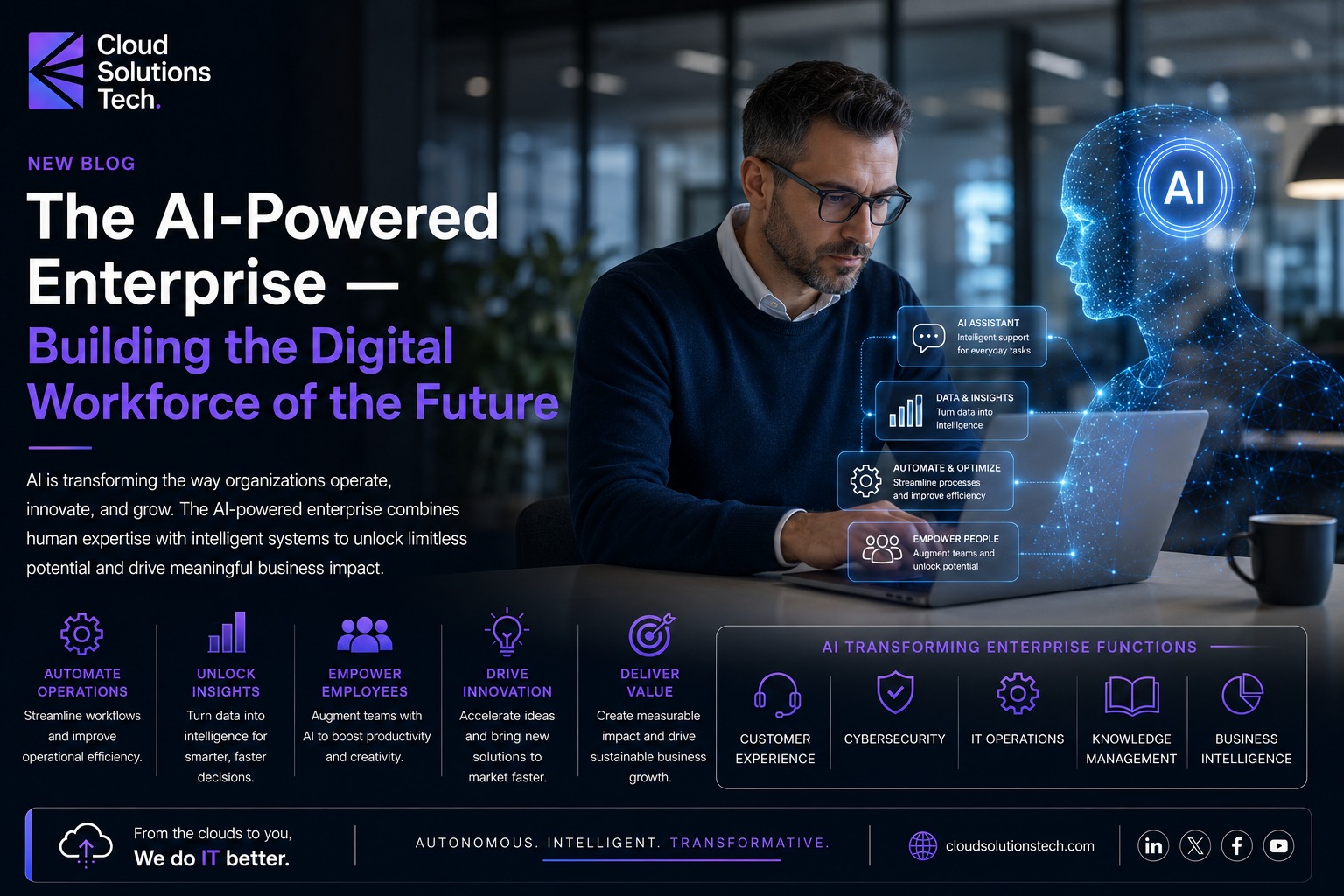
The AI-Powered Enterprise.
Building the Digital Workforce of the Future
Cloud Solutions Tech Executive Insights Series
Artificial Intelligence has evolved far beyond being a productivity tool.
Organizations are no longer asking whether AI can help employees work faster.
Instead, they are asking a much bigger question:
How can AI become part of the workforce itself?
In 2026, leading organizations are embracing a new operating model where humans and AI collaborate as a unified workforce.
This transformation is giving rise to what many industry leaders now call:
- The AI-Powered Enterprise.
- The organizations that successfully adopt this model are gaining significant advantages in productivity, innovation, decision-making, and operational efficiency.
What Is an AI-Powered Enterprise?
An AI-Powered Enterprise is an organization that integrates artificial intelligence into its core operations, business processes, and decision-making frameworks.
Rather than using AI as a standalone tool, these organizations embed intelligence throughout the enterprise.
AI becomes a strategic business capability that supports:
- Employees
- Operations
- Customer experiences
- Security functions
- Knowledge management
- Business intelligence
The result is a digital workforce that augments human expertise and enables organizations to operate more effectively at scale.
The Rise of the Digital Workforce
Historically, organizations relied solely on human workers to perform operational tasks.
Today, enterprises are increasingly deploying:
- AI assistants
- AI agents
- Intelligent automation systems
- Virtual analysts
- Digital service representatives
- Autonomous operational platforms
Together, these technologies form a digital workforce capable of handling routine, repetitive, and data-intensive activities.
Human employees remain critical, but their focus shifts toward:
- Strategy
- Innovation
- Leadership
- Relationship building
- Complex problem-solving
This creates a more productive and efficient organization.
Why Organizations Are Investing in AI-Powered Workforces
Several factors are accelerating adoption.
Growing Operational Complexity
Modern organizations manage:
- Massive datasets
- Multi-cloud environments
- Distributed teams
- Global operations
- Increasing regulatory requirements
AI helps manage this complexity more effectively.
Workforce Challenges
Many industries continue facing:
- Talent shortages
- Skills gaps
- Rising labor costs
AI enables organizations to expand capabilities without proportionally increasing headcount.
Demand for Faster Decision-Making
Business leaders increasingly require real-time insights.
AI systems can analyze information at a scale and speed that humans cannot achieve alone.
How AI Is Transforming Enterprise Functions
Customer Experience
AI-powered organizations use intelligent systems to:
- Personalize customer interactions
- Resolve service requests
- Predict customer needs
- Improve response times
This enhances customer satisfaction while reducing support costs.
Cybersecurity
Security teams are increasingly relying on AI to:
- Detect threats
- Analyze attack patterns
- Prioritize incidents
- Recommend remediation actions
AI acts as a force multiplier for cybersecurity operations.
IT Operations
AI is helping organizations:
- Monitor infrastructure
- Predict failures
- Optimize resources
- Automate incident response
This improves system reliability and operational efficiency.
Knowledge Management
AI-powered knowledge platforms allow employees to:
- Retrieve information instantly
- Summarize complex documents
- Generate reports
- Access organizational expertise
Knowledge becomes more accessible and actionable.
Business Intelligence
AI can analyze trends, identify opportunities, and provide predictive insights that support strategic planning.
Organizations can make better decisions faster.
The Human + AI Partnership
One of the most important lessons emerging in 2026 is that the future is not Human vs. AI.
It is Human + AI.
Successful organizations are designing systems where:
- Humans provide judgment
- AI provides scale
- Humans provide creativity
- AI provides speed
- Humans provide leadership
- AI provides intelligence support
This partnership creates outcomes neither could achieve independently.
Governance Becomes a Strategic Priority
As AI adoption grows, governance becomes increasingly important.
Organizations must establish clear frameworks around:
- Data Privacy: Ensuring sensitive information is protected.
- Security: Controlling AI access to systems and resources.
- Transparency: Understanding how AI reaches conclusions.
- Compliance: Meeting regulatory and industry requirements.
- Accountability: Maintaining human oversight for critical decisions.
- Responsible AI adoption is becoming a competitive differentiator.
The Technology Foundation of the AI-Powered Enterprise
Building a digital workforce requires a strong technology foundation.
Key components include:
- Cloud Infrastructure: Provides scalable compute and storage capabilities.
- AI Platforms: Support model deployment, orchestration, and management.
- Enterprise Data Platforms: Enable AI access to trusted organizational data.
- Security and Governance Frameworks: Protect systems, users, and information.
- Automation Platforms: Allow AI systems to execute tasks across business functions.
- Together, these capabilities create the infrastructure needed for enterprise-scale AI operations.
What Executive Leaders Should Focus On
As organizations build AI-powered enterprises, leadership priorities should include:
- Business Value: Align AI initiatives with measurable outcomes.
- Workforce Enablement: Prepare employees to collaborate effectively with AI.
- Governance: Establish responsible AI practices.
- Security: Protect AI systems and enterprise data.
- Scalability: Build architectures that support future growth.
- The most successful organizations view AI as a strategic transformation, not simply a technology project.
The Competitive Advantage
Organizations that successfully build digital workforces are experiencing:
- Increased productivity
- Faster innovation
- Improved customer experiences
- Reduced operational costs
- Better decision-making
- Greater organizational agility
AI is becoming a foundational capability for long-term competitiveness.
The Future of Work Is Already Here
The AI-powered enterprise is no longer a future concept.
It is becoming a reality across industries worldwide.
Organizations are moving toward environments where:
- AI assists employees
- AI agents execute workflows
- Intelligent systems support decisions
- Digital workers operate alongside human teams
The workplace of the future is being built today.
Final Takeaway
The next phase of digital transformation is not simply about adopting AI.
It is about integrating AI into the workforce itself.
Organizations that successfully combine human expertise with intelligent digital workers will be better positioned to innovate, compete, and grow in an increasingly complex world.
The future belongs to enterprises that can build, govern, and scale their digital workforce responsibly.
Because in 2026, AI is no longer just a tool.
It is becoming a teammate.
What’s Next?
Next Week:
Agentic AI and the Autonomous Enterprise — How Intelligent Systems Are Redefining Business Execution
From the clouds to you,
We do IT better.