
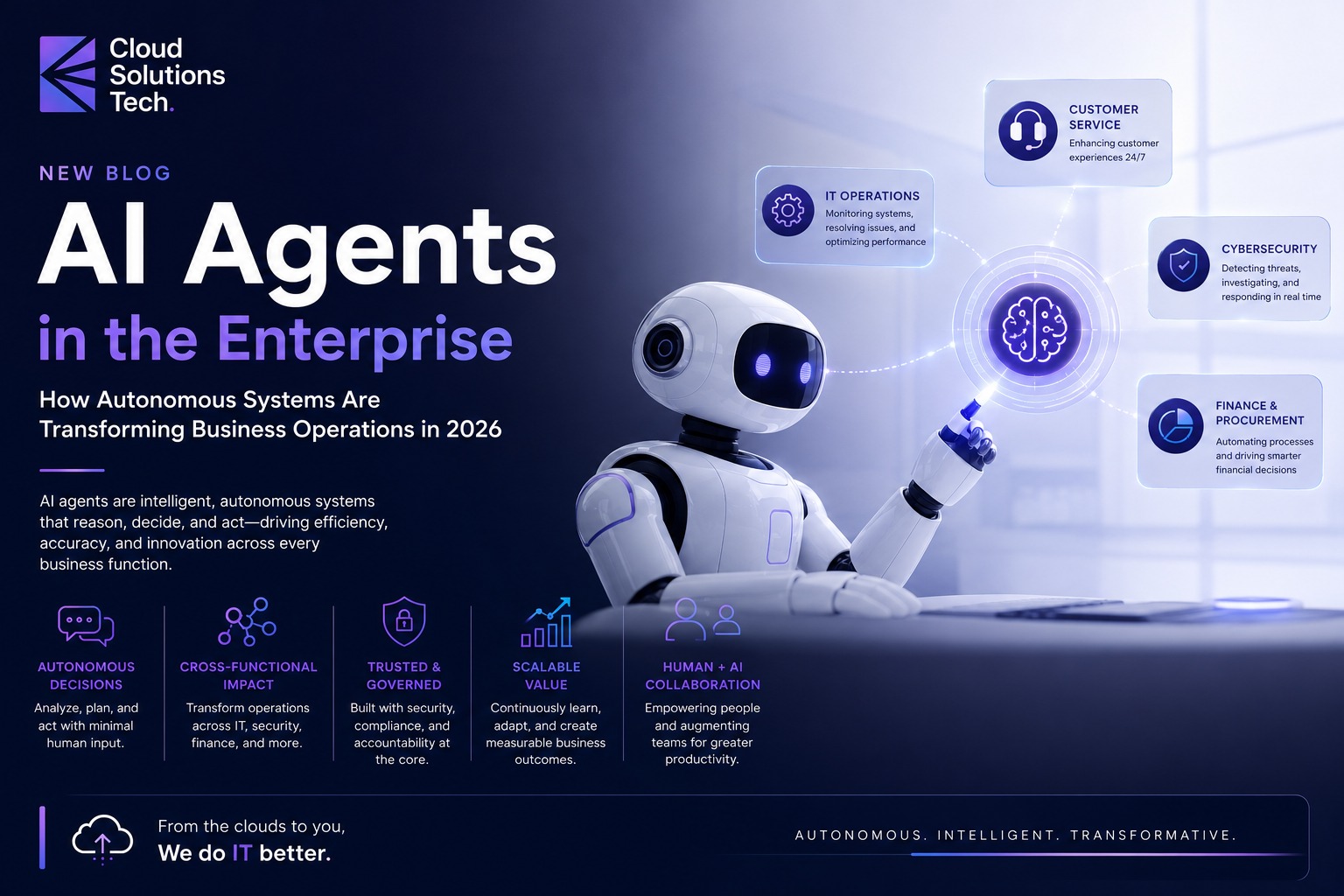
AI Agents in the Enterprise.
How Autonomous Systems Are Transforming Business Operations in 2026
Cloud Solutions Tech Executive Insights Series
For years, organizations have invested heavily in automation.
From workflow engines and robotic process automation (RPA) to AI-powered chatbots, the goal has remained the same:
- Increase efficiency, reduce costs, and improve decision-making.
- But in 2026, a new technology shift is changing the conversation entirely.
- Organizations are moving beyond automation and into the era of AI Agents.
- Unlike traditional automation tools that follow predefined rules, AI agents can reason, plan, make decisions, and execute tasks with minimal human intervention.
- The result is a fundamental transformation in how businesses operate.
What Are AI Agents?
AI agents are intelligent software systems capable of performing tasks autonomously on behalf of users or organizations.
They can:
- Understand objectives
- Analyze information
- Make recommendations
- Execute actions
- Learn from outcomes
- Collaborate with humans and other agents
Rather than simply answering questions, AI agents are designed to accomplish goals.
This distinction is driving significant interest across enterprise, government, healthcare, finance, and technology sectors.
Why AI Agents Matter in 2026.
Organizations today face growing challenges:
- Operational complexity
- Workforce shortages
- Increasing cyber threats
- Rising customer expectations
- Massive data growth
Traditional systems struggle to keep pace.
AI agents help bridge this gap by acting as intelligent digital workers that can operate continuously, analyze vast amounts of information, and respond in real time.
This enables organizations to increase productivity while maintaining agility.
From Automation to Autonomy
Traditional automation follows predefined workflows.
For example:
Automation:
- “If condition A occurs, execute action B.”
- AI agents go much further.
Autonomous Agent:
- Analyze the situation
- Evaluate multiple options
- Select the best course of action
- Execute the task
- Monitor outcomes
- Adjust behavior as needed
This shift from automation to autonomy represents one of the most significant technological changes of the decade.
Enterprise Use Cases for AI Agents
Organizations are rapidly deploying AI agents across multiple business functions.
Customer Service.
AI agents can:
- Resolve support requests
- Analyze customer sentiment
- Escalate complex cases
- Provide personalized responses
This improves customer experience while reducing operational costs.
Cybersecurity Operations
Security teams are increasingly using AI agents to:
- Investigate alerts
- Analyze threats
- Correlate security events
- Recommend remediation actions
- Accelerate incident response
The result is faster and more intelligent cyber defense.
IT Operations.
AI agents can support:
- Infrastructure monitoring
- Root cause analysis
- Capacity planning
- Automated remediation
- Service management workflows
This enables more resilient and efficient operations.
Knowledge Management.
Organizations are deploying AI agents to:
- Search enterprise knowledge bases
- Summarize information
- Generate reports
- Assist employees with decision-making
Knowledge becomes more accessible and actionable.
Finance and Procurement.
AI agents can help automate:
- Invoice processing
- Vendor evaluations
- Contract analysis
- Budget forecasting
- Risk assessments
This reduces manual effort while improving accuracy.
Multi-Agent Systems: The Next Evolution
One of the most exciting developments in 2026 is the emergence of multi-agent systems.
Rather than relying on a single AI agent, organizations are creating teams of specialized agents that collaborate to achieve business objectives.
Examples include:
- Research agents
- Security agents
- Compliance agents
- Analytics agents
- Customer service agents
Together, these agents create a digital workforce capable of handling increasingly sophisticated tasks.
Governance and Trust Remain Critical
As AI agents become more capable, governance becomes increasingly important.
Executive leaders must address:
- Security: How are agents authenticated and authorized?
- Data Protection: What information can agents access?
- Compliance: How are regulatory requirements enforced?
- Auditability: Can agent actions be traced and reviewed?
- Accountability: Who remains responsible for decisions?
Organizations that implement strong governance frameworks will be best positioned to scale AI adoption safely.
AI Agents and the Future Workforce.
A common misconception is that AI agents will replace human workers.
The reality is more nuanced.
The most successful organizations are using AI agents to:
- Eliminate repetitive tasks
- Accelerate workflows
- Support decision-making
- Improve productivity
Human expertise remains essential.
AI agents augment people rather than replace them.
The future workforce will increasingly consist of humans and AI agents working together.
What Executive Leaders Should Focus On.
As AI agent adoption accelerates, leadership priorities should include:
- Strategic Alignment: Ensure AI initiatives support business objectives.
- Governance: Implement policies for responsible AI use.
- Security: Protect enterprise systems and sensitive data.
- Workforce Readiness: Prepare employees to work alongside AI agents.
- Scalability: Build architectures that support long-term AI growth.
The Competitive Advantage
Organizations that successfully adopt AI agents can achieve:
- Faster decision-making
- Improved operational efficiency
- Enhanced customer experiences
- Reduced operational costs
- Greater business agility
- Accelerated innovation
In many industries, AI agents are quickly becoming a competitive differentiator.
The Road Ahead
We are still in the early stages of enterprise AI agent adoption.
Over the next several years, organizations will likely see:
- Autonomous business processes
- AI-powered digital workforces
- Intelligent enterprise operations
- Self-optimizing systems
- AI-driven decision support at scale
The organizations that prepare today will be positioned to lead tomorrow.
Final Takeaway
AI agents represent the next major evolution in enterprise technology.
They are transforming how organizations operate, make decisions, and deliver value.
In 2026, the question is no longer whether AI agents will impact business operations.
The question is:
- How quickly can organizations adopt them responsibly and effectively?
- The future belongs to enterprises that can combine human expertise with intelligent autonomous systems.
What’s Next?
Next Week:
The AI-Powered Enterprise — Building the Digital Workforce of the Future
From the clouds to you,
We do IT better.