
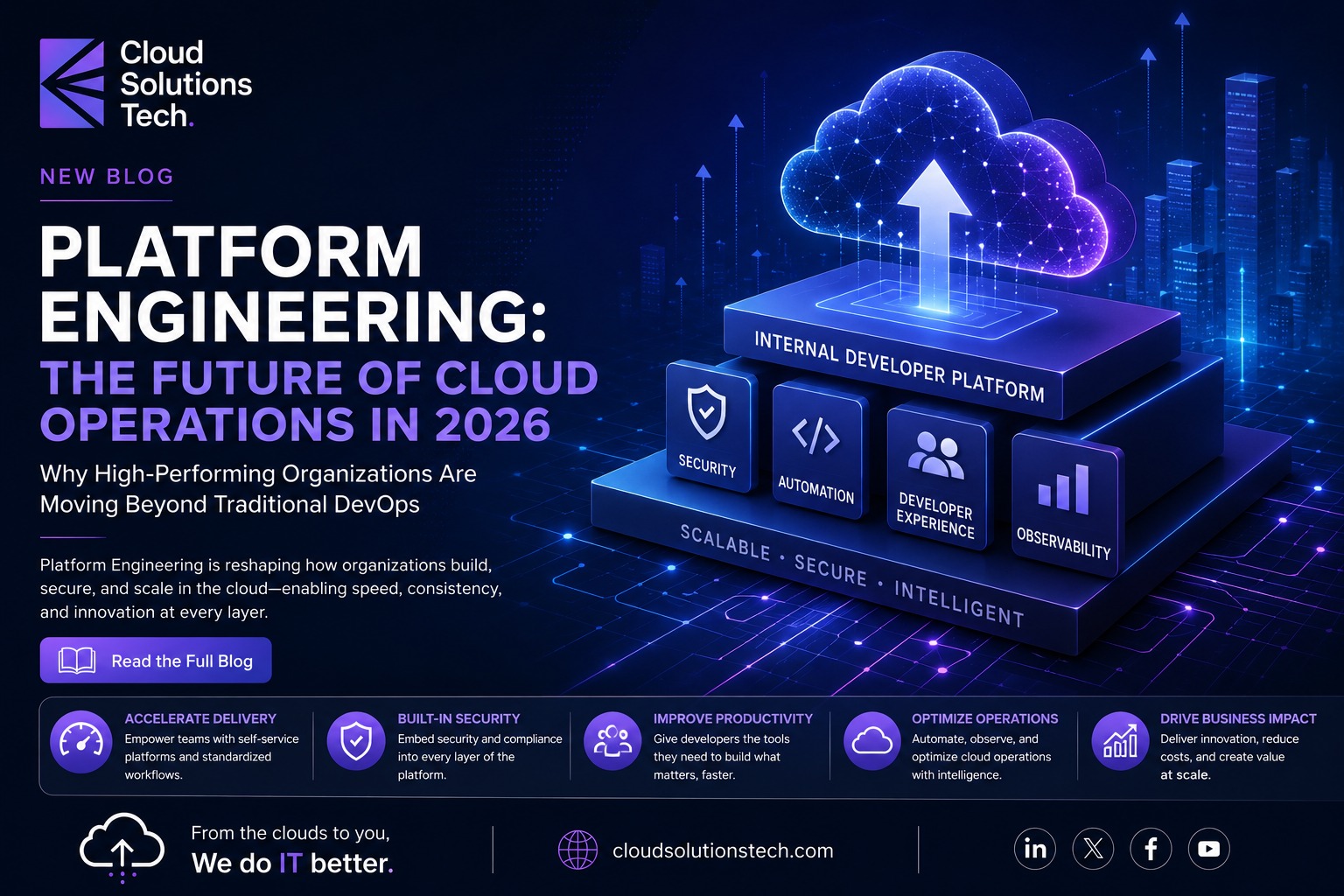
Platform Engineering: The Future of Cloud Operations in 2026
Why High-Performing Organizations Are Moving Beyond Traditional DevOps
Cloud Solutions Tech Executive Insights Series
Over the past decade, DevOps transformed how organizations build and deliver software.
By breaking down barriers between development and operations teams, DevOps accelerated innovation, improved collaboration, and enabled organizations to move faster than ever before.
However, as cloud environments continue to expand in complexity, many organizations are discovering a new challenge:
The very success of cloud adoption has created operational complexity at scale.
This is why a new discipline is rapidly emerging across enterprise, government, and highly regulated industries:
Platform Engineering.
In 2026, Platform Engineering is becoming one of the most important trends in cloud operations and digital transformation.
What Is Platform Engineering?
Platform Engineering is the practice of building and managing internal cloud platforms that enable development teams to deploy and operate applications securely, consistently, and efficiently.
Rather than requiring every development team to become experts in:
- Cloud architecture
- Security controls
- Networking
- Kubernetes
- Compliance frameworks
- Infrastructure automation
Platform teams create reusable services and standardized environments that simplify delivery.
Think of it as creating a secure “cloud operating system” for the organization.
Why Platform Engineering Is Gaining Momentum
Many organizations have reached a point where cloud adoption has become difficult to manage.
Common challenges include:
- Inconsistent security controls
- Duplicate infrastructure efforts
- Configuration drift
- Rising operational costs
- Compliance complexity
- Developer productivity issues
Platform Engineering addresses these challenges by providing standardized, self-service capabilities.
The result is:
- Faster delivery
- Stronger governance
- Improved security
- Better developer experience
The Rise of Internal Developer Platforms (IDPs)
One of the key concepts driving Platform Engineering is the Internal Developer Platform (IDP).
An IDP provides developers with:
- Self-service infrastructure
- Standardized deployment workflows
- Secure application templates
- Automated compliance controls
- Centralized observability
Instead of spending days configuring environments, developers can focus on building business value.
This shift significantly improves productivity while reducing operational risk.
Platform Engineering and Security
One reason executives are investing heavily in Platform Engineering is security.
Security teams can embed controls directly into the platform rather than relying on manual reviews.
This includes:
- Identity controls
- Encryption standards
- Logging requirements
- Vulnerability scanning
- Policy enforcement
- Compliance validation
Security becomes part of the platform itself.
This creates a stronger and more consistent security posture across the organization.
The Role of AI in Platform Engineering
Artificial Intelligence is accelerating the adoption of Platform Engineering.
Organizations are increasingly using AI to:
- Detect configuration drift
- Recommend infrastructure optimizations
- Improve incident response
- Automate compliance monitoring
- Predict capacity requirements
- Assist developers with deployments
The combination of AI and Platform Engineering is creating a new generation of intelligent cloud operations.
Why Executive Leaders Should Care
Platform Engineering is not simply a technical initiative.
It directly impacts business outcomes.
- Faster Innovation: Development teams spend less time managing infrastructure and more time building products.
- Reduced Risk: Standardized environments reduce security and compliance gaps.
- Lower Costs: Shared services eliminate duplication and improve resource utilization.
- Improved Governance: Organizations gain greater visibility and control across cloud environments.
- Better Talent Retention: Developers are more productive and experience less operational friction.
What High-Performing Organizations Are Doing
Leading organizations are investing in:
- Internal Developer Platforms
- Platform Engineering teams
- Infrastructure as Code
- AI-powered operations
- Self-service cloud capabilities
- Automated security controls
These organizations understand that future success depends on enabling developers while maintaining governance.
The Future of Cloud Operations
As organizations continue embracing cloud, AI, and automation, Platform Engineering will become a foundational capability.
The future belongs to organizations that can:
- Simplify complexity
- Standardize operations
- Secure at scale
- Accelerate innovation
Platform Engineering provides the framework to achieve all four.
Final Takeaway
Cloud environments are becoming more powerful—but also more complex.
Platform Engineering is emerging as the solution that allows organizations to scale cloud operations without sacrificing security, governance, or developer productivity.
In 2026, the question is no longer whether Platform Engineering matters.
The question is:
How quickly can your organization adopt it?
What’s Next?
Next Week:
AI Agents in the Enterprise — How Autonomous Systems Are Transforming Business Operations in 2026
From the clouds to you,
We do IT better.
Hello,
This is a very nice write up. However, I have not heard much about platform engineering. I know a bit about system engineering, networking, kubernetes, etc. Interested in the platform engineering and also what you think of AI agents, API, and webhooks. Thank you.
Hello,
Thank you for your comment.
Platform engineering builds on skills like systems administration, networking, cloud, and Kubernetes. The goal is to create tools and platforms that make it easier for developers to deploy and manage applications.
As for AI agents, APIs, and webhooks, I believe they’re becoming essential. APIs connect systems, webhooks enable real-time automation, and AI agents use both to automate tasks and improve efficiency.
With your background in systems, networking, and Kubernetes, you’re already on a good path toward platform engineering.
Thanks again for your interest!