
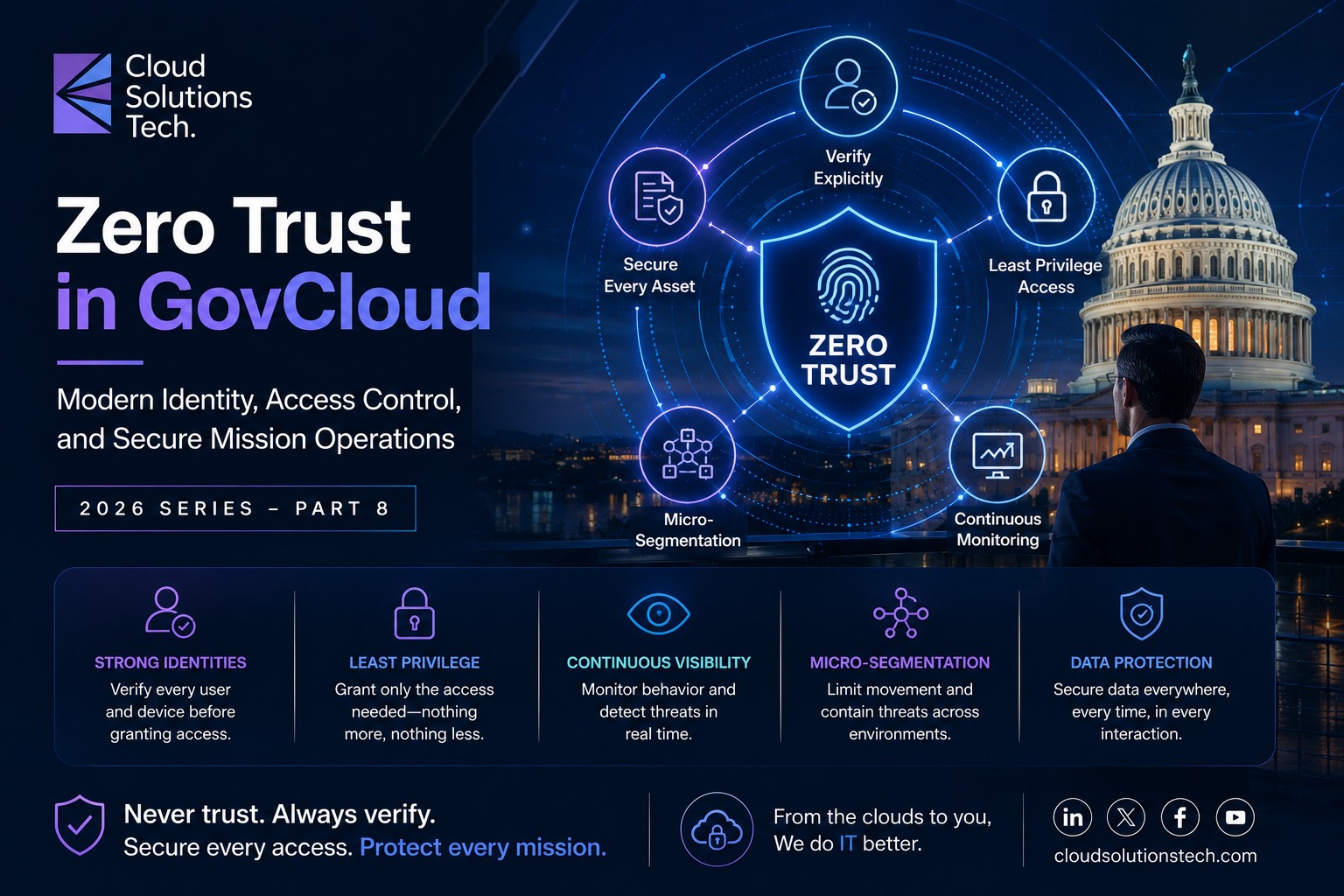
Zero Trust in GovCloud
Modern Identity, Access Control, and Secure Mission Operations (2026 Series – Part 8)
As cloud adoption continues to evolve across government and regulated industries, traditional security models are rapidly becoming obsolete.
The old assumption was simple:
If a user or system was inside the network, it could be trusted.
In 2026, that assumption is considered one of the greatest security risks organizations can make.
Modern cloud environments require a fundamentally different approach: Zero Trust.
And in GovCloud environments, Zero Trust is no longer a future initiative, it is becoming the operational standard for secure mission execution.
What Is Zero Trust?
Zero Trust is a security model based on one core principle:
Never trust. Always verify.
Rather than relying on network location or implicit trust, Zero Trust continuously validates:
- User identity
- Device posture
- Access context
- Application behavior
- Data sensitivity
Every request is authenticated, authorized, and continuously evaluated before access is granted.
Why Zero Trust Matters in GovCloud
Government and regulated organizations operate some of the most sensitive digital environments in the world.
These environments now support:
- Remote and hybrid workforces
- Multi-cloud architectures
- AI-enabled systems
- Third-party integrations
- Mission-critical workloads
At the same time, cyber threats are becoming more sophisticated, persistent, and identity-focused.
This creates a new reality:
The identity layer has become the new security perimeter.
Zero Trust addresses this challenge directly.
The Shift from Perimeter Security to Identity-Centric Security
Traditional security models focused heavily on protecting the network edge.
Zero Trust changes the focus to:
- Who is requesting access
- What they are accessing
- Why they need access
- Whether the behavior is normal or risky
This model dramatically reduces the impact of compromised accounts, insider threats, and lateral movement inside cloud environments.
Core Pillars of Zero Trust in GovCloud
High-maturity organizations build Zero Trust strategies around several foundational principles.
1. Strong Identity Verification
Identity is the foundation of Zero Trust.
Organizations implement:
- Multi-factor authentication (MFA)
- Federated identity management
- Conditional access policies
- Role-based access control (RBAC)
- Just-in-time privilege elevation
The objective is to ensure that access is continuously validated, not permanently assumed.
2. Least Privilege Access
Users and systems should only have access to the exact resources required to perform their functions.
This minimizes:
- Overexposure
- Insider risk
- Privilege escalation pathways
In GovCloud environments, least privilege is essential for maintaining compliance and reducing attack surface.
3. Continuous Monitoring and Behavioral Analysis
Zero Trust is not a one-time authentication event.
Organizations continuously monitor:
- Login behavior
- Device posture
- Access patterns
- Application activity
- Network traffic
Suspicious activity can trigger:
- Additional authentication
- Session restrictions
- Automated remediation workflows
4. Micro-Segmentation
Rather than allowing broad network access, Zero Trust environments use segmentation to isolate workloads and systems.
This limits:
- Lateral movement
- Blast radius during incidents
- Unauthorized east-west traffic
Micro-segmentation is especially important in multi-account and multi-cloud GovCloud architectures.
5. Data-Centric Security
Zero Trust extends beyond systems and networks, it protects the data itself.
Organizations apply:
- Data classification policies
- Encryption standards
- Access monitoring
- Usage controls
The focus shifts from simply securing infrastructure to securing the mission-critical information that powers operations.
Zero Trust and Compliance in 2026
Zero Trust is increasingly aligned with major regulatory and government initiatives, including:
- Federal Zero Trust mandates
- NIST Zero Trust Architecture guidance
- FedRAMP modernization efforts
- Executive cybersecurity directives
Organizations are no longer being encouraged to adopt Zero Trust.
They are being expected to operationalize it.
The Role of Automation and AI
As environments grow more complex, Zero Trust operations are becoming increasingly automated.
Modern platforms now leverage:
- AI-assisted anomaly detection
- Adaptive authentication
- Automated policy enforcement
- Risk-based access decisions
This enables organizations to make security decisions dynamically and at scale.
What Executive Leaders Should Focus On
Zero Trust is not simply a technology deployment, It is a strategic transformation.
Leadership priorities should include:
- Identity Governance: Ensuring strong control over users, devices, and privileges.
- Operational Visibility: Maintaining continuous insight into access behavior and cloud activity.
- Risk Reduction: Reducing exposure through segmentation and least privilege.
- User Experience: Balancing security with operational efficiency.
- Long-Term Scalability: Building architectures that support future cloud, AI, and multi-cloud growth.
Common Misconceptions About Zero Trust
- “Zero Trust means trusting nobody.” In reality, it means verifying continuously and intelligently.
- “Zero Trust is a single product.” Zero Trust is a framework and operational model, not a tool.
- “Zero Trust slows operations.” When implemented correctly, it improves both security and operational confidence.
The Future of Secure Mission Operations
Zero Trust is rapidly becoming the foundation of modern government cloud security.
Organizations are moving toward:
- Identity-driven operations
- Context-aware access control
- Continuous risk evaluation
- Intelligent automation
The future of GovCloud security is adaptive, automated, and continuously verified.
Final Takeaway
In 2026, trust can no longer be assumed in cloud environments. It must be earned continuously.
Zero Trust enables organizations to:
- Secure modern mission operations
- Reduce identity-related risk
- Strengthen compliance posture
- Operate confidently in increasingly complex digital ecosystems
In GovCloud, Zero Trust is no longer an emerging concept.
It is becoming the blueprint for secure cloud operations.
What’s Next in This Series
Part 9 (Next Week):
The Future of GovCloud — AI, Quantum Security, and the Next Era of Secure Digital Infrastructure
From the clouds to you,
We do IT better.